Tennessee Permit Practice Test 6
25 questions written from the Tennessee Comprehensive Driver License Manual, with an explanation and page citation for every answer.
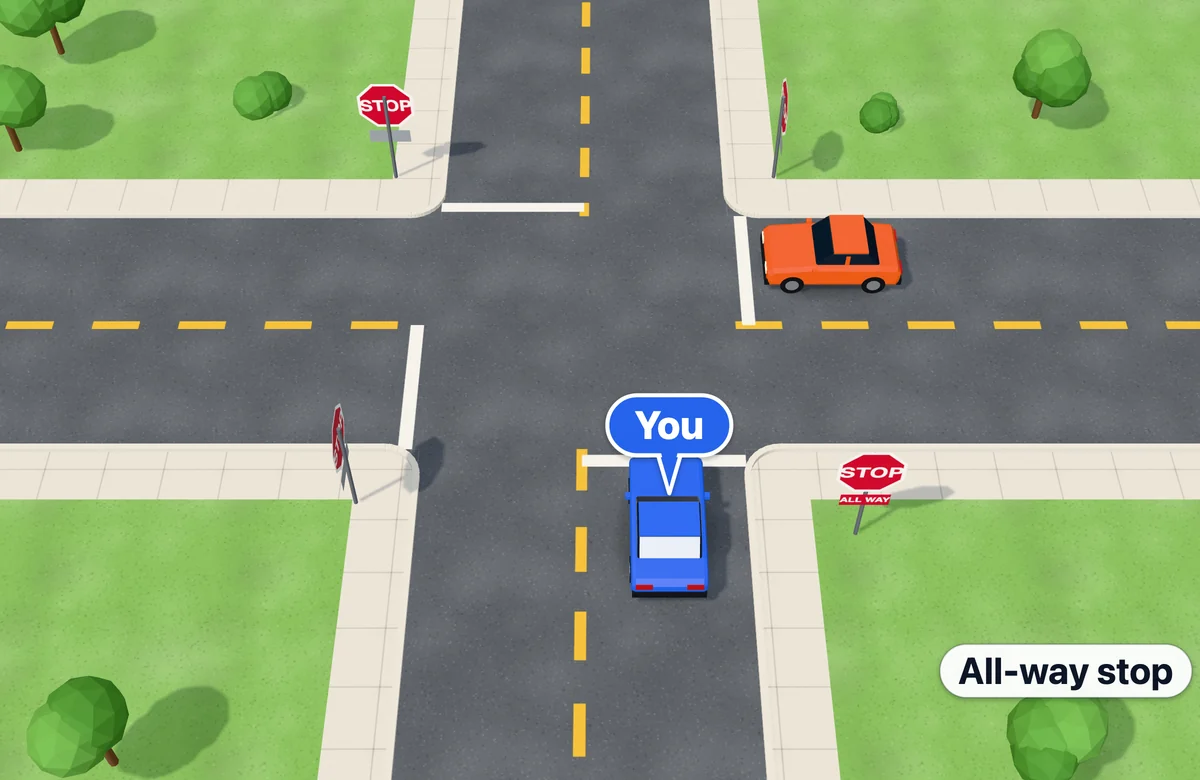
At an all-way stop, you and another driver stop at the same time. The other car is on your right. Who goes first?
Keyboard: press 1–4 or A–D to answer, Enter for the next question, S to save, R to read aloud, P to pause reading, L to listen and answer.
About this test
These questions were written from the Tennessee Comprehensive Driver License Manual (Information current as of July 1, 2022). 14 of the 20 Tennessee questions in this test cover rules that are specific to Tennessee or differ between states. Every answer comes with an explanation and a link to the exact page it comes from, so you can check it yourself.
Your answers are saved in this browser. Questions you miss go to My mistakes so you can practice them again.
Sample questions from this test
View diagram
At an all-way stop, you and another driver stop at the same time. The other car is on your right. Who goes first?
- A Whoever is going straight
- B Whoever is driving the bigger vehicle
- C You, because you are on the left
- D The driver on the right
Show answer
D. The driver on the right
At an all-way stop the first vehicle to arrive goes first. If two arrive at the same time, the driver on the left yields to the driver on the right. Stay cautious even when it is your turn.
Source: Tennessee Comprehensive Driver License Manual, page 68
In Tennessee, how far before a turn must you turn on your turn signal?
- A At least 200 feet
- B At least 50 feet
- C At least 25 feet
- D At least 100 feet
Show answer
B. At least 50 feet
Turn on your signal at least 50 feet before a turn or lane change. Signaling early lets other drivers, cyclists and pedestrians plan around you, but it never gives you the right-of-way.
Source: Tennessee Comprehensive Driver License Manual, page 70

View diagram
In normal conditions, what is the minimum following distance recommended in the Tennessee manual?
- A 6 seconds
- B 2 seconds
- C 1 second
- D A car length per 20 mph
Show answer
B. 2 seconds
Count from when the car ahead passes a fixed point; you should not reach that point before "one-thousand-two." Increase the gap to at least four seconds at night, in bad weather, on the interstate, or behind a motorcycle.
Source: Tennessee Comprehensive Driver License Manual, page 63
A driver under 18 builds up points on their record. How many points within 12 months bring a notice of proposed suspension?
- A 3 or more points
- B 10 or more points
- C 12 or more points
- D 6 or more points
Show answer
D. 6 or more points
Drivers under 18 who reach 6 or more points within 12 months receive a notice of proposed suspension; 1 to 5 points brings an advisory letter. The lower limit for young drivers reflects their higher crash risk.
Source: Tennessee Comprehensive Driver License Manual, page 100
It is daytime and raining hard enough that you need your windshield wipers constantly. What does Tennessee law require?
- A Use parking lights only
- B Turn on your hazard flashers
- C Turn on your headlights
- D Nothing extra during daylight
Show answer
C. Turn on your headlights
Tennessee law requires headlights whenever rain, mist or snow calls for constant use of your wipers. Lights help oncoming drivers and pedestrians see you in poor visibility.
Source: Tennessee Comprehensive Driver License Manual, page 59