Texas Permit Practice Test 1
26 questions written from the Texas Driver Handbook (DL-7), with an explanation and page citation for every answer.
What is the youngest age at which a Texas teen can apply for a learner license?
Keyboard: press 1–4 or A–D to answer, Enter for the next question, S to save, R to read aloud, P to pause reading, L to listen and answer.
About this test
These questions were written from the Texas Driver Handbook (DL-7) (Revised January 2026). 13 of the 21 Texas questions in this test cover rules that are specific to Texas or differ between states. Every answer comes with an explanation and a link to the exact page it comes from, so you can check it yourself.
Your answers are saved in this browser. Questions you miss go to My mistakes so you can practice them again.
Sample questions from this test
What is the youngest age at which a Texas teen can apply for a learner license?
- A 14
- B 16
- C 17
- D 15
Show answer
D. 15
A Texas learner license can be issued at 15. You must first finish the classroom portion of driver education and pass the vision and knowledge exams.
A front tire blows out at highway speed. What should you do?
- A Ease off the gas, steer straight, and brake gently
- B Brake hard immediately
- C Steer sharply onto the shoulder to get out of traffic right away
- D Speed up to keep the car stable
Show answer
A. Ease off the gas, steer straight, and brake gently
If a tire blows out, do not hit the brakes hard. Take your foot off the gas, gently apply the brakes, and steer straight ahead to a stop.
On a two-lane road, how close to an intersection or railroad crossing may you drive on the left side of the road to pass?
- A Not within 50 feet
- B Not within 100 feet
- C Not within 200 feet
- D Not within 500 feet
Show answer
B. Not within 100 feet
Never drive on the left side within 100 feet of an intersection, railroad crossing, bridge, viaduct or tunnel. Vehicles may enter or appear without warning in those places.
View diagram
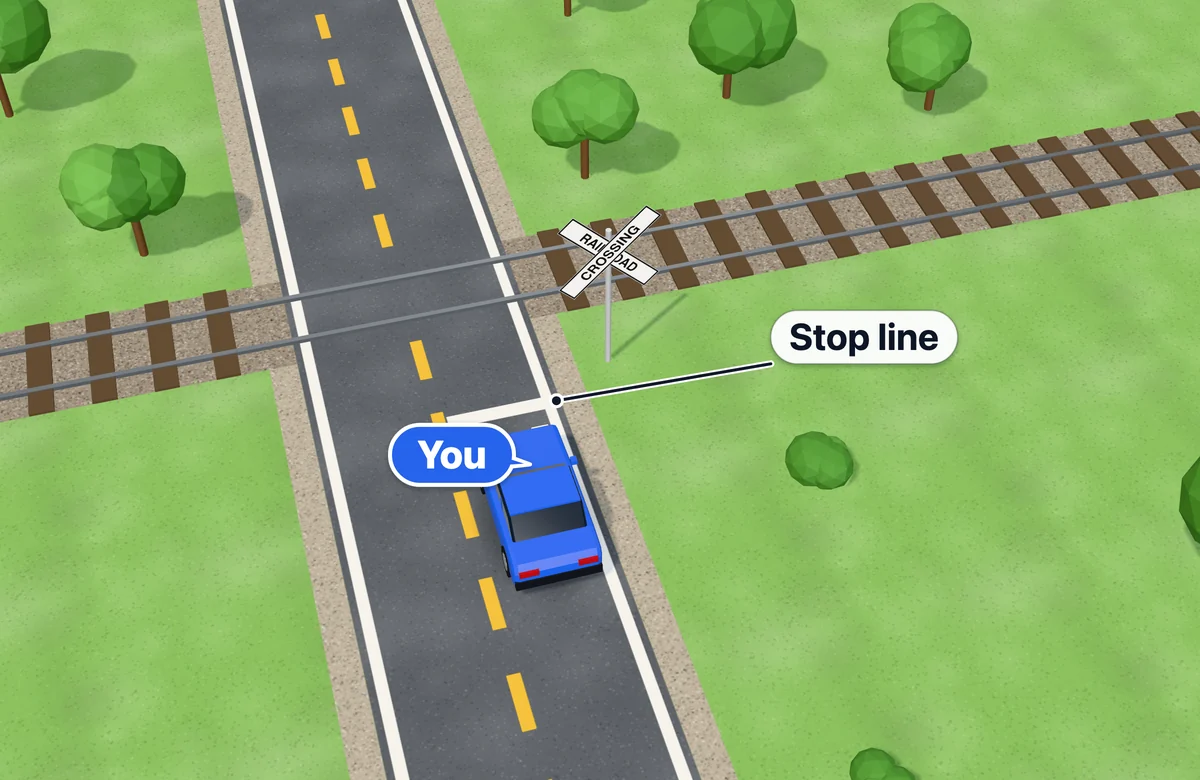
When you must stop at a railroad crossing in Texas, how far from the nearest rail should you stop?
- A Between 15 and 50 feet
- B Between 5 and 10 feet
- C Between 50 and 100 feet
- D Exactly 20 feet
Show answer
A. Between 15 and 50 feet
Stop between 15 and 50 feet from the nearest rail when signals flash, a gate is down, a flagger warns you, or a train is close. Stay stopped until it is safe to proceed.
View diagram
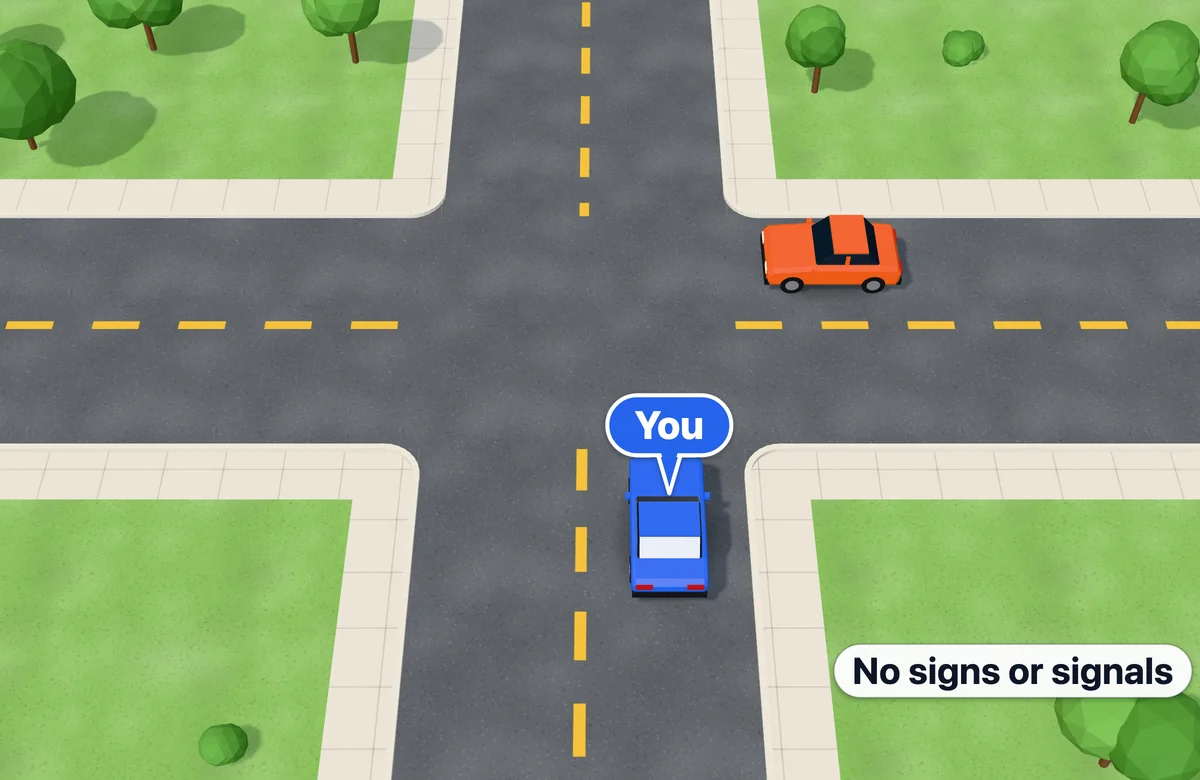
At an intersection with no signs or signals, another car is approaching at the same time from your right. What should you do?
- A Yield to the car on your right
- B Go first because you are driving straight
- C Speed up to clear the intersection first
- D Wave the other driver through only if it is a truck
Show answer
A. Yield to the car on your right
At an uncontrolled intersection, yield to any vehicle that has entered or is approaching on your right. Still check left, because the other driver may not follow the rule.