Texas Permit Practice Test 6
25 questions written from the Texas Driver Handbook (DL-7), with an explanation and page citation for every answer.
How close to a fire hydrant may you park in Texas?
Keyboard: press 1–4 or A–D to answer, Enter for the next question, S to save, R to read aloud, P to pause reading, L to listen and answer.
About this test
These questions were written from the Texas Driver Handbook (DL-7) (Revised January 2026). 14 of the 20 Texas questions in this test cover rules that are specific to Texas or differ between states. Every answer comes with an explanation and a link to the exact page it comes from, so you can check it yourself.
Your answers are saved in this browser. Questions you miss go to My mistakes so you can practice them again.
Sample questions from this test
How close to a fire hydrant may you park in Texas?
- A No closer than 15 feet
- B No closer than 10 feet
- C No closer than 20 feet
- D No closer than 30 feet
Show answer
A. No closer than 15 feet
Texas prohibits parking or standing within 15 feet of a fire hydrant. Firefighters need room to reach the hydrant quickly.
In Texas, which sign shape is used exclusively for stop signs?
- A Equilateral triangle
- B Pentagon
- C Round
- D Octagon
Show answer
D. Octagon
The eight-sided octagon is used only for stop signs, so you can recognize one even from behind or when covered with snow.
View diagram
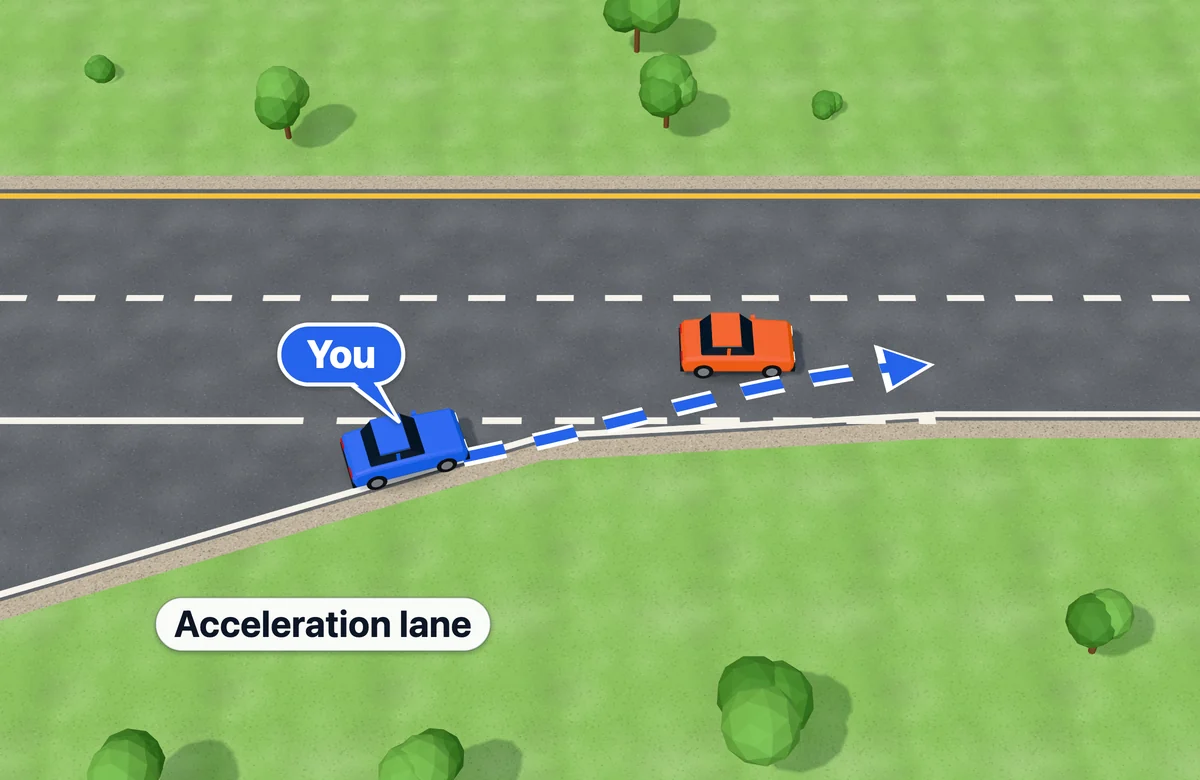
When entering a freeway from an on-ramp, who has the right-of-way?
- A You, because you are merging
- B Whichever vehicle is larger
- C Whichever vehicle is faster
- D Vehicles already on the freeway
Show answer
D. Vehicles already on the freeway
Yield to vehicles already on the highway. Use the speed change lane, signal left, and when clear, speed up to merge with the flow of traffic.
What is the minimum property-damage liability coverage required in Texas?
- A $15,000
- B $30,000
- C $50,000
- D $25,000
Show answer
D. $25,000
Texas requires at least $25,000 of liability coverage for property damage you cause. Together with $30,000 and $60,000 for injuries, this is the 30/60/25 minimum.
You are using high beams at night. Within how many feet of an oncoming vehicle must you switch to low beams?
- A 200 feet
- B 300 feet
- C 500 feet
- D 1,000 feet
Show answer
C. 500 feet
Use low beams within 500 feet of an approaching vehicle and within 300 feet when following one. High beams can blind other drivers.