Vermont Permit Practice Test 1
25 questions written from the Vermont Driver's Manual (VN-007), with an explanation and page citation for every answer.
What is the minimum age to take the Vermont learner's permit test?
Keyboard: press 1–4 or A–D to answer, Enter for the next question, S to save, R to read aloud, P to pause reading, L to listen and answer.
About this test
These questions were written from the Vermont Driver's Manual (VN-007) (2025 edition). 15 of the 20 Vermont questions in this test cover rules that are specific to Vermont or differ between states. Every answer comes with an explanation and a link to the exact page it comes from, so you can check it yourself.
Your answers are saved in this browser. Questions you miss go to My mistakes so you can practice them again.
Sample questions from this test
What is the minimum age to take the Vermont learner's permit test?
- A 14
- B 16
- C 15 and a half
- D 15
Show answer
D. 15
You must be at least 15 years old to take Vermont's learner's permit test. If you are 15, 16 or 17, a parent or legal guardian must also sign your application.
Under Vermont law, how far before a turn or lane change must you signal?
- A At least 50 feet
- B At least 200 feet
- C At least 100 feet
- D At least 500 feet
Show answer
C. At least 100 feet
Vermont law requires a turn signal at least 100 feet before a turn or lane change. Signaling 3 to 5 seconds ahead covers this requirement.
Unless a sign says otherwise, what is the maximum speed on Vermont roads other than the Interstate?
- A 55 mph
- B 45 mph
- C 50 mph
- D 60 mph
Show answer
C. 50 mph
Vermont's maximum speed on all roads is 50 mph unless a different limit is posted. Interstates have their own 65 mph maximum.
View diagram
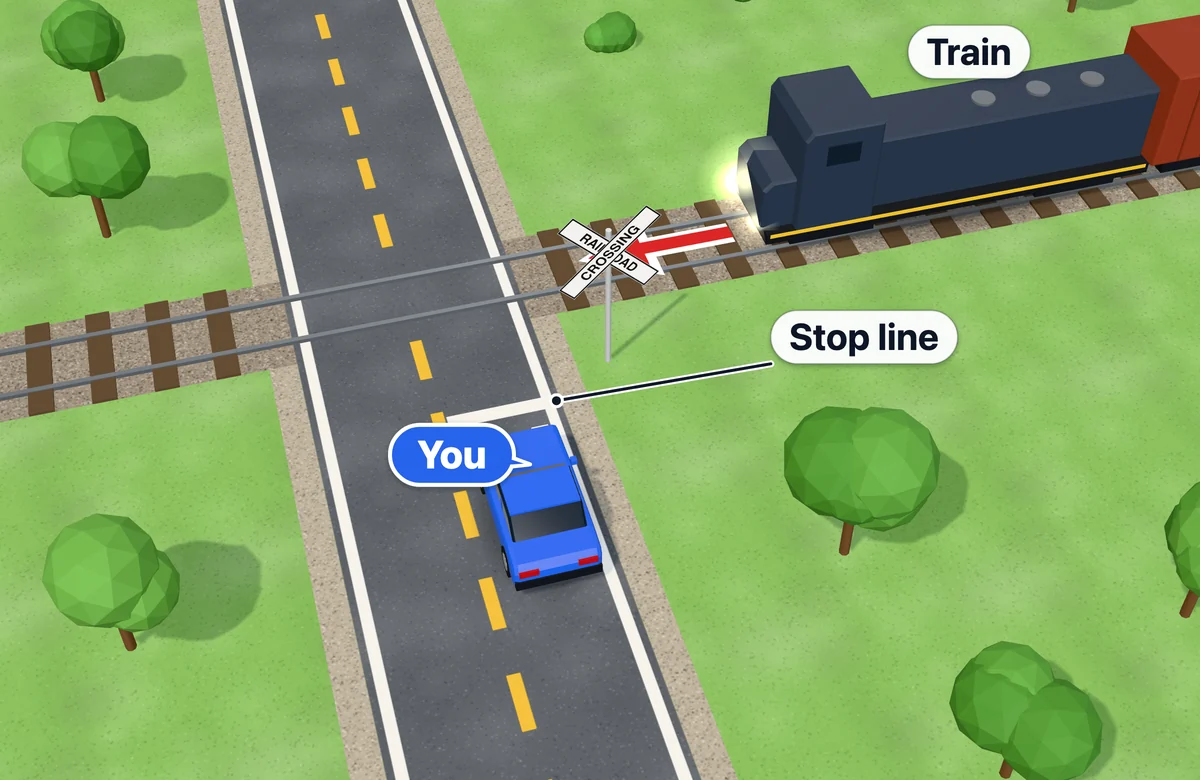
When a train is approaching a crossing, how far from the nearest rail must you stop?
- A At least 5 feet
- B At least 15 feet
- C At least 50 feet
- D At least 100 feet
Show answer
B. At least 15 feet
Vermont law requires you to stop not less than 15 feet from the nearest rail when lights, gates, a flagger, a train or its whistle signal a train, or a stop sign is posted. Go only when it is safe.
In fog or heavy snow, at what visibility does Vermont law require headlights?
- A When you cannot clearly see persons or vehicles 500 feet ahead
- B When you cannot clearly see persons or vehicles 1,000 feet ahead
- C When you cannot see 100 feet ahead
- D Only when a sign tells you to
Show answer
A. When you cannot clearly see persons or vehicles 500 feet ahead
If you cannot clearly see persons or vehicles 500 feet ahead, Vermont law requires headlights. In fog, heavy rain or heavy snow, use low beams.