Vermont Permit Practice Test 3
25 questions written from the Vermont Driver's Manual (VN-007), with an explanation and page citation for every answer.
How much space should you leave between your car and a bicyclist you are passing in Vermont?
Keyboard: press 1–4 or A–D to answer, Enter for the next question, S to save, R to read aloud, P to pause reading, L to listen and answer.
About this test
These questions were written from the Vermont Driver's Manual (VN-007) (2025 edition). 15 of the 20 Vermont questions in this test cover rules that are specific to Vermont or differ between states. Every answer comes with an explanation and a link to the exact page it comes from, so you can check it yourself.
Your answers are saved in this browser. Questions you miss go to My mistakes so you can practice them again.
Sample questions from this test
How much space should you leave between your car and a bicyclist you are passing in Vermont?
- A At least 2 feet
- B At least 3 feet
- C At least 6 feet
- D At least 4 feet
Show answer
D. At least 4 feet
Leave at least four feet between the right side of your vehicle and a bicyclist you pass. If the road is too narrow, wait until it is safe to pass.
View diagram
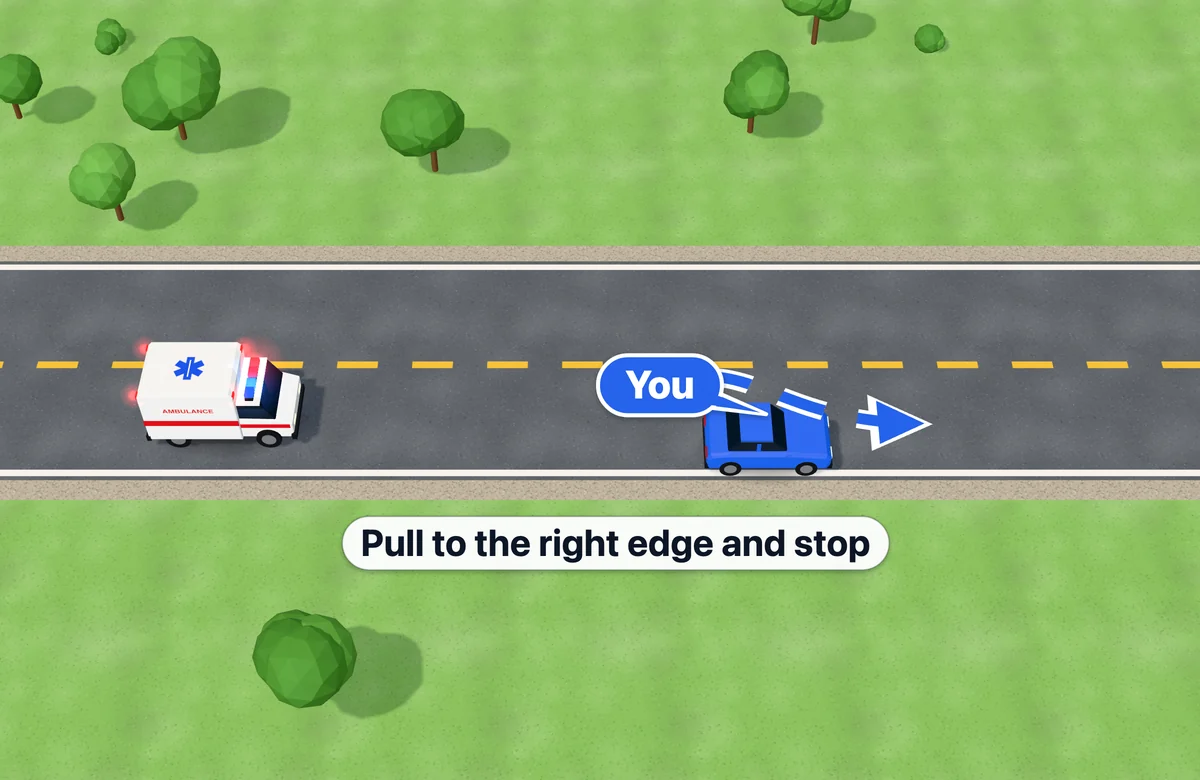
A vehicle with flashing blue or red lights and a siren approaches from behind. What does Vermont law require?
- A Pull to the right side of the road and stop until it passes
- B Speed up to stay ahead of it
- C Stop immediately right where you are, even in an intersection
- D Slow down but keep driving in your lane
Show answer
A. Pull to the right side of the road and stop until it passes
When a vehicle with flashing blue or red lights or a siren approaches from any direction, pull over to the right and stop. Stay stopped until it has gone by.
You approach an intersection where the traffic lights are completely dark because of a power failure. What should you do?
- A Stop as if there were stop signs in all directions
- B Proceed if no cross traffic is visible
- C Yield only to traffic on your right
- D Treat it as a flashing yellow light
Show answer
A. Stop as if there were stop signs in all directions
If a signal is dark, as in a power failure, stop as if there were stop signs in all directions. Then take turns safely.
When must you send a written crash report to the Vermont DMV?
- A Within 72 hours if anyone is injured or damage is $3,000 or more
- B Within 10 days if anyone is injured or the damage is over $1,000
- C Within 24 hours for every crash
- D Only if police did not come to the scene
Show answer
A. Within 72 hours if anyone is injured or damage is $3,000 or more
If anyone is injured or total property damage is $3,000 or more, you must send a written report to the Vermont DMV Commissioner within 72 hours. Crash reports help the state improve roads.
How close to a crosswalk at an intersection may you park in Vermont?
- A No closer than 6 feet
- B No closer than 30 feet
- C No closer than 20 feet
- D No closer than 50 feet
Show answer
C. No closer than 20 feet
You may not park within 20 feet of a crosswalk at an intersection. Parked cars near crosswalks hide pedestrians from drivers.