Virginia Permit Practice Test 1
25 questions written from the Virginia Driver's Manual (DMV 39), with an explanation and page citation for every answer.
Part one of Virginia's knowledge exam has 10 road-sign questions. How many must you answer correctly before you can move on to part two?
Keyboard: press 1–4 or A–D to answer, Enter for the next question, S to save, R to read aloud, P to pause reading, L to listen and answer.
About this test
These questions were written from the Virginia Driver's Manual (DMV 39) (April 2026). 13 of the 20 Virginia questions in this test cover rules that are specific to Virginia or differ between states. Every answer comes with an explanation and a link to the exact page it comes from, so you can check it yourself.
Your answers are saved in this browser. Questions you miss go to My mistakes so you can practice them again.
Sample questions from this test
Part one of Virginia's knowledge exam has 10 road-sign questions. How many must you answer correctly before you can move on to part two?
- A At least 9 of them
- B At least 8 of them
- C At least 7 of them
- D All 10 of them
Show answer
D. All 10 of them
Virginia's sign section is all-or-nothing: you must get every one of the 10 sign questions right before the computer lets you start part two. Signs are tested this strictly because you have to recognise them instantly on the road.
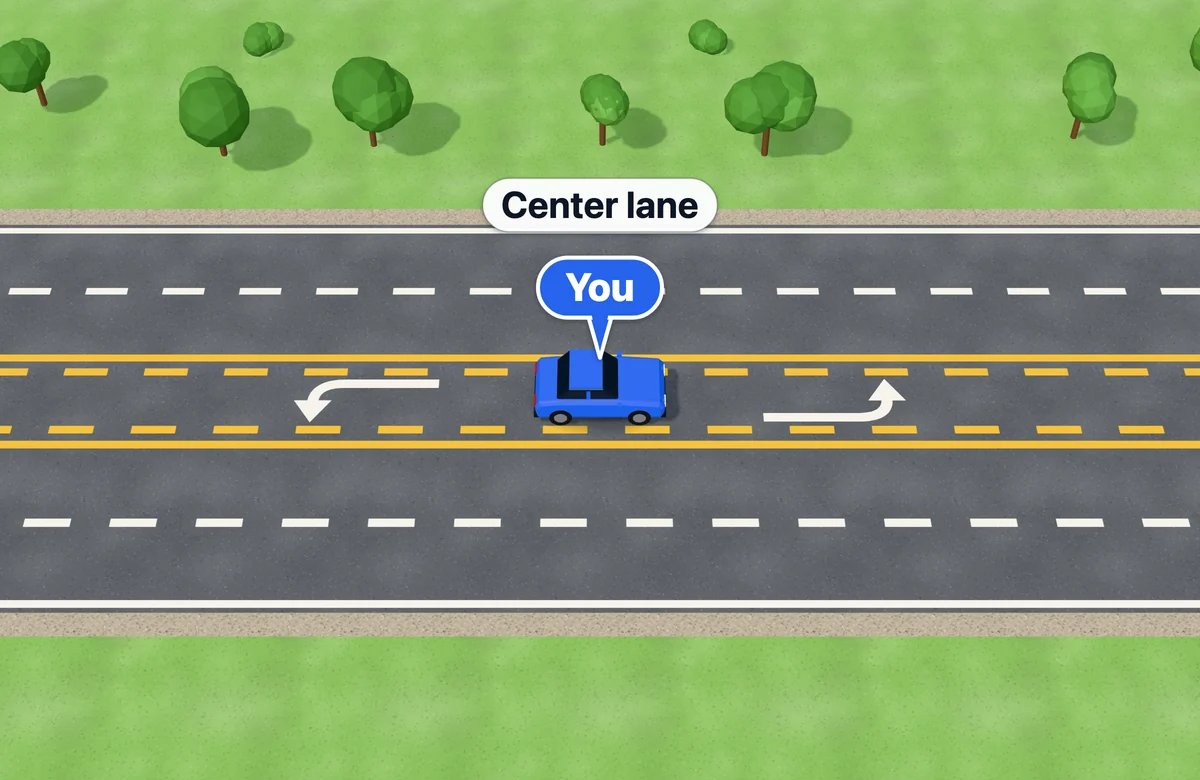
View diagram
A center lane is marked on both sides by a solid yellow line with a broken yellow line. How far may you travel in it?
- A No more than 150 feet
- B No more than 300 feet
- C No more than 500 feet
- D As far as you need to reach your turn
Show answer
A. No more than 150 feet
This center lane is for left turns by drivers in either direction, and Virginia limits travel in it to 150 feet. It is a place to wait for your turn, not a travel or passing lane.
It is daytime and light rain means you need your windshield wipers. What does Virginia law say about headlights?
- A They are optional in daylight
- B You must turn them on whenever wipers are needed for weather
- C They are needed only after sunset
- D They are required only when visibility drops below 100 feet ahead
Show answer
B. You must turn them on whenever wipers are needed for weather
Virginia law requires headlights whenever you use windshield wipers because of bad weather, and when rain, fog, snow or sleet reduces visibility to 500 feet. Headlights help other drivers see you.
On a Virginia multi-lane highway, what is the left lane for?
- A Drivers going the speed limit
- B Trucks and buses
- C Passing only, not cruising
- D Any driver who wants to go faster
Show answer
C. Passing only, not cruising
Virginia's manual says the left lane is for passing only, not cruising. Stay in the right lane if you are slower than the traffic around you, and move back right after you pass.
You are driving a car on a paved rural highway in Virginia with no speed limit signs. What is the maximum legal speed?
- A 45 MPH
- B 55 MPH
- C 60 MPH
- D 65 MPH
Show answer
B. 55 MPH
When no sign is posted, Virginia's maximum on roads that are not school, business, residential or unpaved is 55 MPH. Higher limits, like those on interstates, must be posted.