Virginia Permit Practice Test 4
25 questions written from the Virginia Driver's Manual (DMV 39), with an explanation and page citation for every answer.
Unless a sign shows a different limit, what is the maximum speed for a car in a Virginia residential area?
Keyboard: press 1–4 or A–D to answer, Enter for the next question, S to save, R to read aloud, P to pause reading, L to listen and answer.
About this test
These questions were written from the Virginia Driver's Manual (DMV 39) (April 2026). 12 of the 20 Virginia questions in this test cover rules that are specific to Virginia or differ between states. Every answer comes with an explanation and a link to the exact page it comes from, so you can check it yourself.
Your answers are saved in this browser. Questions you miss go to My mistakes so you can practice them again.
Sample questions from this test
Unless a sign shows a different limit, what is the maximum speed for a car in a Virginia residential area?
- A 20 MPH
- B 25 MPH
- C 30 MPH
- D 35 MPH
Show answer
B. 25 MPH
Virginia's default limit is 25 MPH in school, business and residential areas, 35 MPH on unpaved roads and 55 MPH on all other roads. These apply whenever no speed limit sign says otherwise.
After passing a car on a two-lane road, when is it safe to move back into the right lane?
- A When you can see its front in your rearview mirror
- B As soon as your rear bumper clears its front bumper
- C When you are one car length ahead of it
- D When the driver flashes the headlights at you
Show answer
A. When you can see its front in your rearview mirror
Signal, then return to the right lane once you can see the front of the passed vehicle in your rearview mirror. That gap gives the other driver room to slow or stop behind you.

View diagram
On a dry road at 40 MPH, what minimum following distance does the Virginia manual recommend?
- A 1 second
- B 2 seconds
- C 3 seconds
- D 4 seconds
Show answer
C. 3 seconds
Virginia uses a 2-3-4 second rule on dry roads: 2 seconds under 35 MPH, 3 seconds at 35-45 MPH and 4 seconds at 46-70 MPH. Count from when the car ahead passes a fixed object until you reach it.
What score do you need on part two (general knowledge) of the Virginia knowledge exam?
- A At least 90 percent correct
- B At least 70 percent correct
- C Every question correct
- D At least 80 percent correct
Show answer
D. At least 80 percent correct
Part two is multiple choice on laws and safe driving, and you must answer at least 80 percent correctly (24 of 30). Only part one, the sign section, requires a perfect score.
View diagram
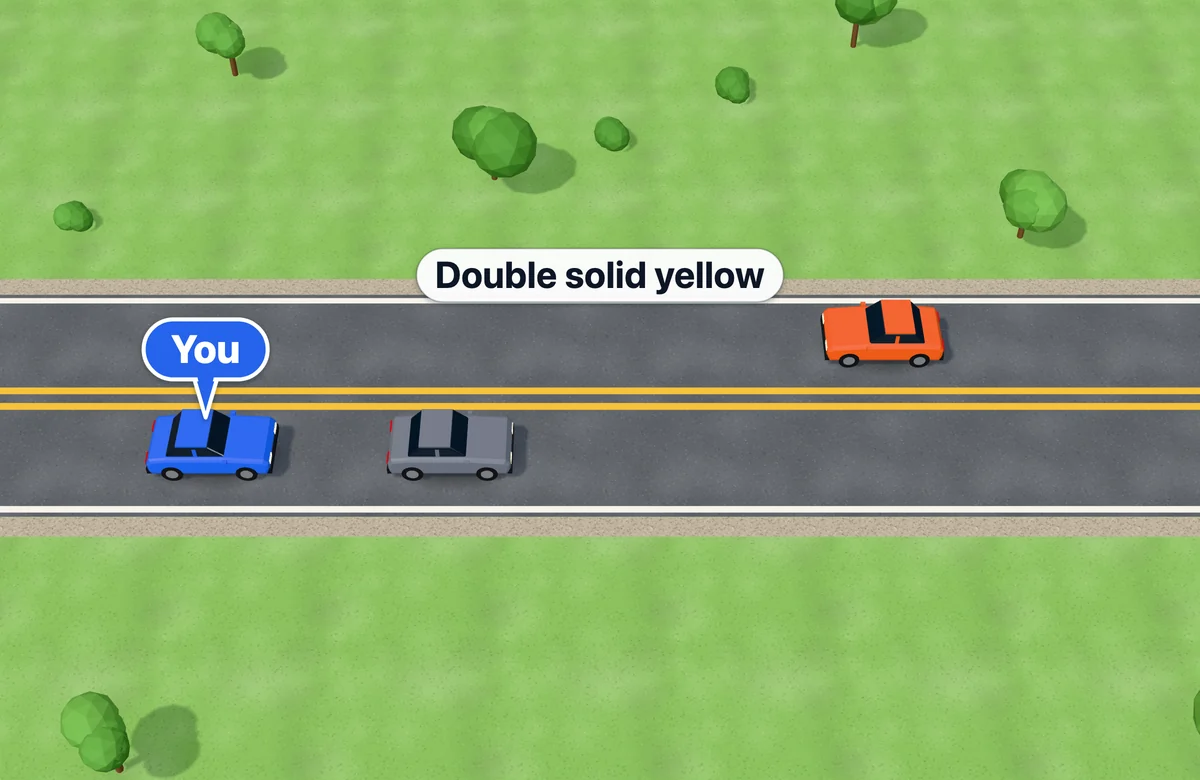
On a road with double solid yellow center lines, when may you cross them?
- A To turn left, or to pass a bicyclist or pedestrian when the other lane is clear
- B To pass a slow car, if you can see far enough ahead
- C Never, for any reason
- D Only to pass a vehicle going under 25 MPH
Show answer
A. To turn left, or to pass a bicyclist or pedestrian when the other lane is clear
Double solid yellow lines mean no passing in either direction. You may cross them only to make a left turn or to pass pedestrians, bicyclists, or riders of scooters or skateboards, and only when the opposite lane is clear.