Wisconsin permit test: parking & stopping
Where you may not park, distances from hydrants and crossings, curbs and hills. 4 questions.
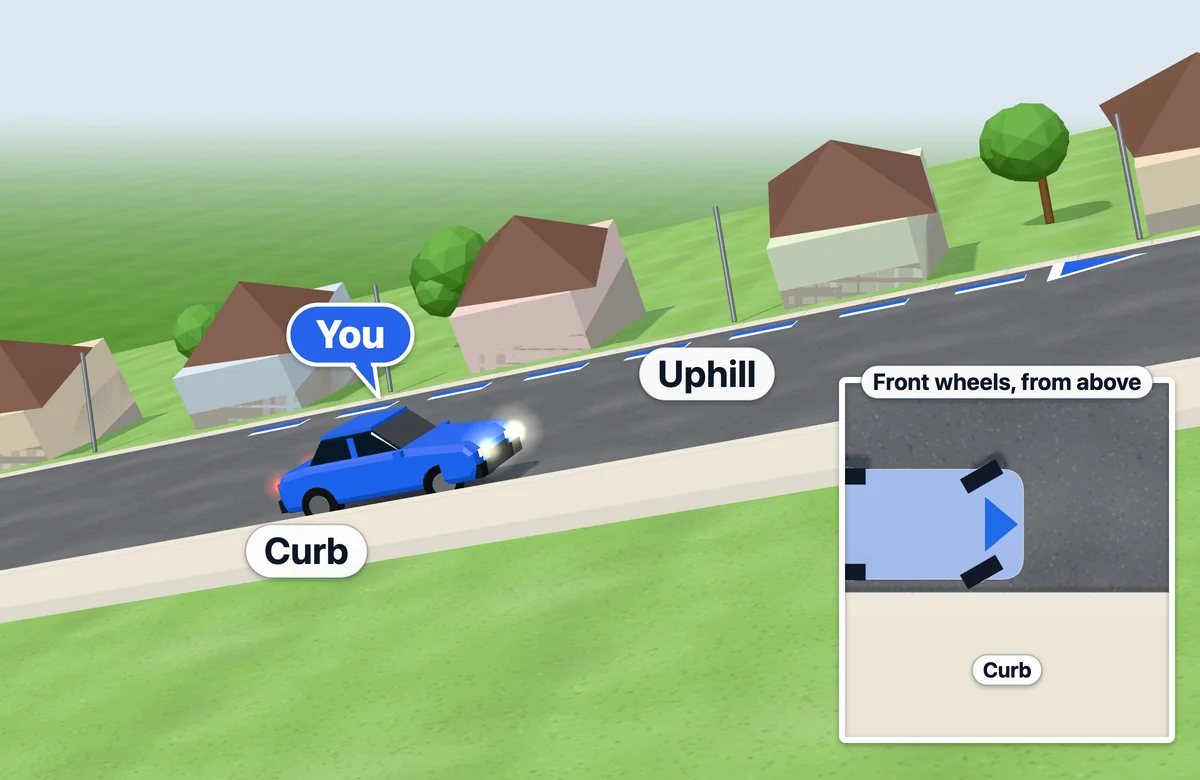
You park facing uphill next to a curb. Which way should you turn your front wheels?
Keyboard: press 1–4 or A–D to answer, Enter for the next question, S to save, R to read aloud, P to pause reading, L to listen and answer.
Sample parking & stopping questions
View diagram
You park facing uphill next to a curb. Which way should you turn your front wheels?
- A Slightly right, toward the curb
- B All the way to the left
- C Straight ahead
- D All the way to the right
Show answer
B. All the way to the left
Uphill with a curb, turn your wheels all the way left so the tire rests against the curb if the car rolls back. Then put the car in park and set the parking brake.
View diagram
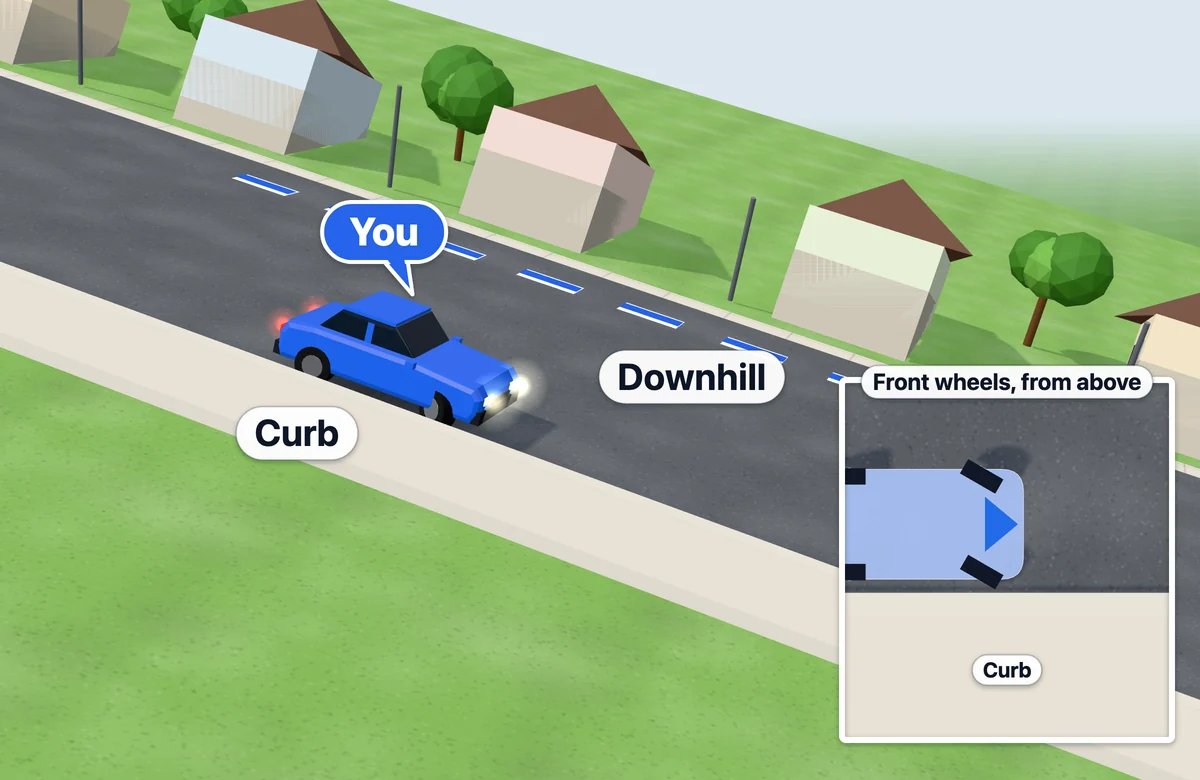
You park facing downhill next to a curb. Which way should you turn your front wheels?
- A It does not matter if the brake is set
- B All the way to the left
- C Straight ahead
- D All the way to the right
Show answer
D. All the way to the right
When parked downhill, turn your wheels all the way to the right so the car rolls toward the curb or edge, not into traffic. Set the emergency brake.
Where is parking not allowed, according to the handbook?
- A Along yellow-marked curbs and in front of fire hydrants
- B Along white-marked curbs on residential streets
- C Anywhere on the right side of the road
- D Within 100 feet of any intersection
Show answer
A. Along yellow-marked curbs and in front of fire hydrants
Do not park where the curb is marked yellow or in front of fire hydrants, and check for No Parking signs. Park far enough from travel lanes not to interfere with traffic.
Who may park in a space marked Reserved Parking for vehicles with disability plates or cards?
- A Anyone, for up to 15 minutes
- B Anyone with flashers on while waiting
- C Any driver over age 65
- D Only vehicles with a valid disabled permit or plate
Show answer
D. Only vehicles with a valid disabled permit or plate
Reserved parking spaces are only for vehicles with a valid disabled parking ID permit or disabled license plate. Using one without a permit is illegal.