California permit test: highways & freeways
Entering, exiting and driving on limited-access roads. 4 questions.
When entering a freeway from an on-ramp, how should you merge?
Keyboard: press 1–4 or A–D to answer, Enter for the next question, S to save, R to read aloud, P to pause reading, L to listen and answer.
Sample highways & freeways questions
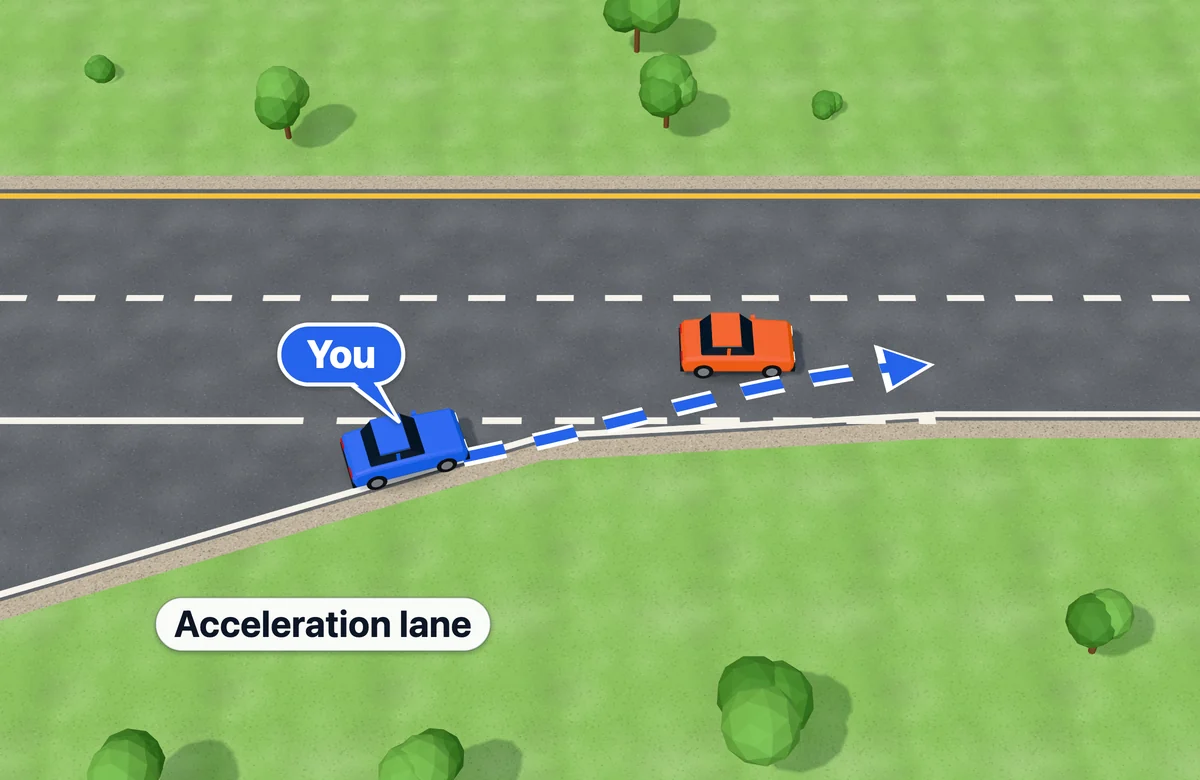
View diagram
When entering a freeway from an on-ramp, how should you merge?
- A Stop at the end of the ramp, then go
- B At or near the speed of freeway traffic
- C Faster than all traffic to get ahead
- D Well below the speed of traffic
Show answer
B. At or near the speed of freeway traffic
Use the on-ramp to reach the speed of freeway traffic, then merge into a big enough gap. Do not stop unless absolutely necessary, and remember that highway traffic has the right-of-way.
Once you are in the proper lane to exit a freeway, when should you signal?
- A Just as you start moving into the exit lane
- B About two seconds before the exit
- C About one mile before the exit
- D About five seconds (roughly 400 feet) before the exit
Show answer
D. About five seconds (roughly 400 feet) before the exit
Signal about five seconds, roughly 400 feet, before you exit. Change lanes one at a time well before the exit and do not cross solid lines.
Your car breaks down on a California freeway and you pull onto the right shoulder. What does the handbook advise?
- A Raise the hood and stand behind the car to wave traffic
- B Call 511 or use a call box, then stay inside with your seat belt on
- C Walk to the nearest exit to find a phone and help
- D Stay in the car with the seat belt off so you can exit fast
Show answer
B. Call 511 or use a call box, then stay inside with your seat belt on
Pull to the right shoulder, exit on the right side if you must get out, and call 511 or use a call box. Then stay in the car with your seat belt on until help arrives, unless there is no room on the shoulder or a guardrail lets you wait safely away from traffic.
A CHP officer turns on emergency lights and slowly weaves across all freeway lanes ahead of you. What should you do?
- A Pull onto the shoulder and stop until the officer is gone
- B Turn on your flashers, slow to the officer's speed, and do not pass
- C Brake hard right away to put more space between you
- D Change lanes and pass the patrol car carefully on the right
Show answer
B. Turn on your flashers, slow to the officer's speed, and do not pass
This is a traffic break, used to slow traffic around hazards or in heavy fog. Turn on your emergency flashers, slow gradually to the officer's speed, and do not drive past the patrol car until its lights go off.