California Permit Practice Test 1
26 questions written from the California Driver's Handbook (DL 600), with an explanation and page citation for every answer.
What is the youngest age at which a California teen can be issued a provisional instruction permit?
Keyboard: press 1–4 or A–D to answer, Enter for the next question, S to save, R to read aloud, P to pause reading, L to listen and answer.
About this test
These questions were written from the California Driver's Handbook (DL 600) (DL 600 ENGLISH). 18 of the 21 California questions in this test cover rules that are specific to California or differ between states. Every answer comes with an explanation and a link to the exact page it comes from, so you can check it yourself.
Your answers are saved in this browser. Questions you miss go to My mistakes so you can practice them again.
Sample questions from this test
What is the youngest age at which a California teen can be issued a provisional instruction permit?
- A 14 and a half years old
- B 15 years old
- C 16 years old
- D 15 and a half years old
Show answer
D. 15 and a half years old
California minors can get an instruction permit once they are at least 15½ and have completed driver education. The permit stage comes first so you can build supervised experience before you can be licensed at 16.
You turn on your windshield wipers because of light rain. What does California law also require?
- A Turn on your emergency flashers
- B Turn on your high-beam headlights
- C Turn on only your parking lights
- D Turn on your low-beam headlights
Show answer
D. Turn on your low-beam headlights
If you need wipers because of fog, rain or snow, you must turn on your low-beam headlights. This helps other drivers see you in poor visibility.
You are driving, and your 15-year-old passenger is not wearing a seat belt. The passenger's parent is not in the car. Who can be ticketed?
- A No one
- B Only the passenger
- C You, the driver
- D Only the parent
Show answer
C. You, the driver
Drivers and passengers must wear seat belts. If a passenger is under 16 and not buckled, the driver can get a ticket.
View diagram
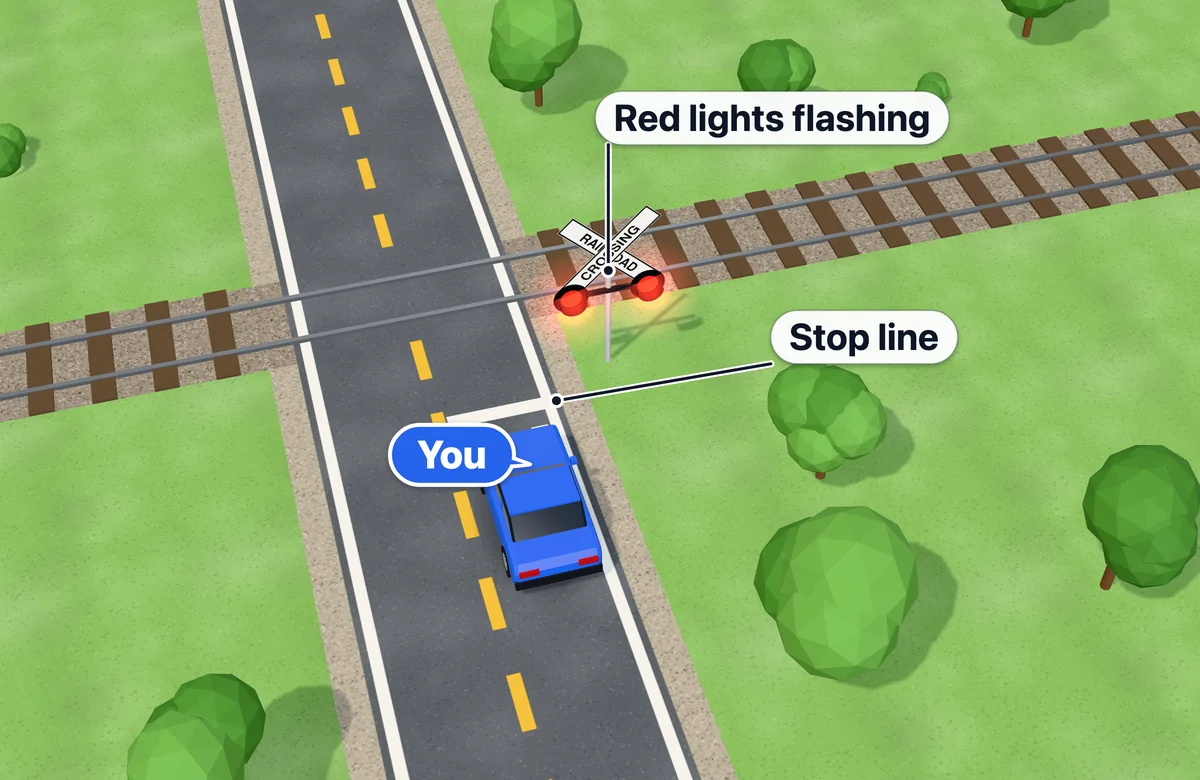
Railroad signals show a train is coming. Where should you stop?
- A Right at the edge of the nearest rail
- B At least 5 feet from the nearest track
- C At least 15 feet from the nearest track
- D At least 50 feet from the nearest track
Show answer
C. At least 15 feet from the nearest track
When crossing devices or a person warn that a train is coming, stop at least 15 feet from the nearest track. That keeps you well clear of the train, and you should never stop on the tracks themselves.
Where there is no curb extension, how close to a crosswalk may you park in California?
- A No closer than 15 feet
- B No closer than 20 feet
- C No closer than 30 feet
- D No closer than 10 feet
Show answer
B. No closer than 20 feet
California bans parking within 20 feet of a marked or unmarked crosswalk, or within 15 feet where there is a curb extension. Keeping this space clear lets drivers see pedestrians stepping off the curb.