California permit test: right of way & intersections
Who goes first at stops, uncontrolled intersections, roundabouts and when entering roads. 6 questions.
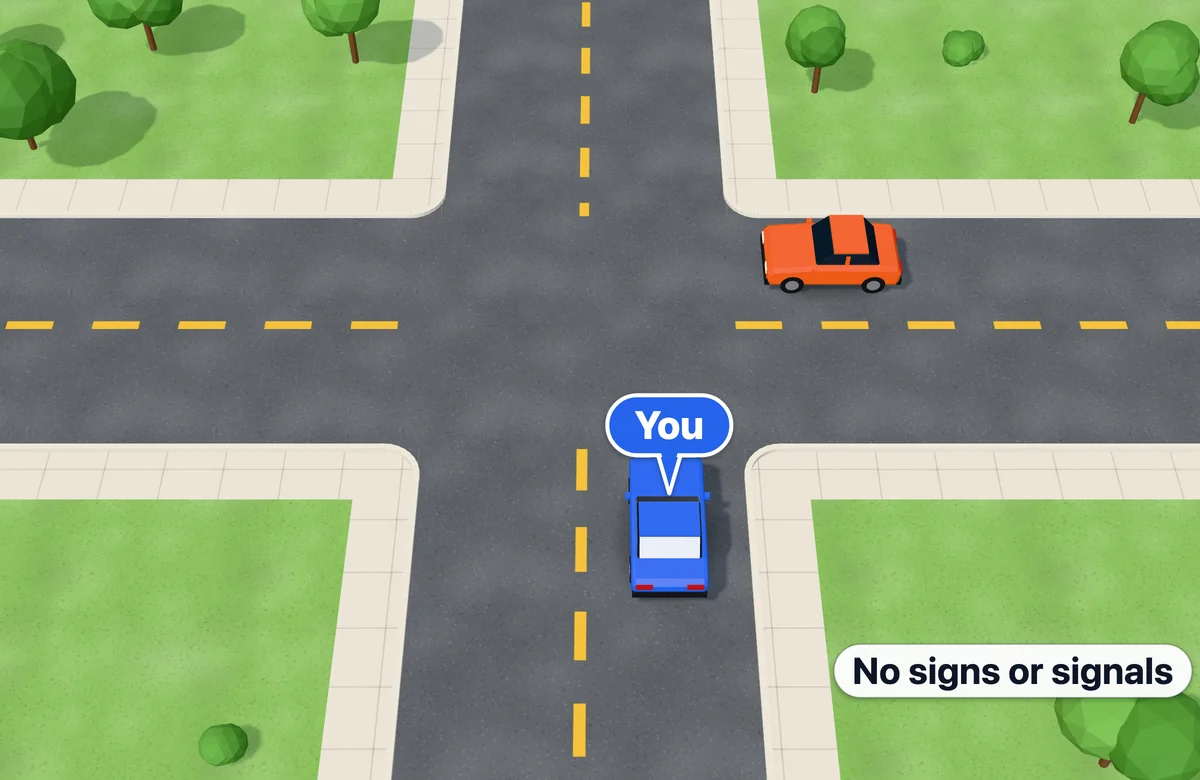
You reach an intersection with no stop signs, yield signs or traffic signals (an uncontrolled intersection). Another car reaches it at the same time from the cross street on your right. Who should go first?
Keyboard: press 1–4 or A–D to answer, Enter for the next question, S to save, R to read aloud, P to pause reading, L to listen and answer.
Sample right of way & intersections questions
View diagram
You reach an intersection with no stop signs, yield signs or traffic signals (an uncontrolled intersection). Another car reaches it at the same time from the cross street on your right. Who should go first?
- A The larger of the two vehicles
- B Whichever car is going straight
- C You do, because you are on the left
- D The car on your right
Show answer
D. The car on your right
At an intersection without STOP or YIELD signs, the vehicle that arrives first goes first. If you arrive at the same time, give the right-of-way to the vehicle, pedestrian or bicyclist on your right. Here the other car is on your right, so you wait and let it go.
You reach a T intersection with no STOP or YIELD signs, and you are on the road that ends. Who has the right-of-way?
- A You, because you arrived first
- B The vehicle on your right
- C Traffic on the through road
- D Whoever is turning left
Show answer
C. Traffic on the through road
At a T intersection without signs, vehicles, bicyclists and pedestrians on the through road have the right-of-way. The driver on the road that ends must wait for a safe gap.
Two cars meet on a steep, narrow mountain road where neither can pass. Who must back up?
- A The smaller of the two cars
- B The car facing downhill
- C The car that arrived second
- D The car facing uphill
Show answer
B. The car facing downhill
On a steep, narrow road, the vehicle facing uphill has the right-of-way. The downhill car backs up because it has more control backing uphill than a car rolling backward down the hill.
View diagram
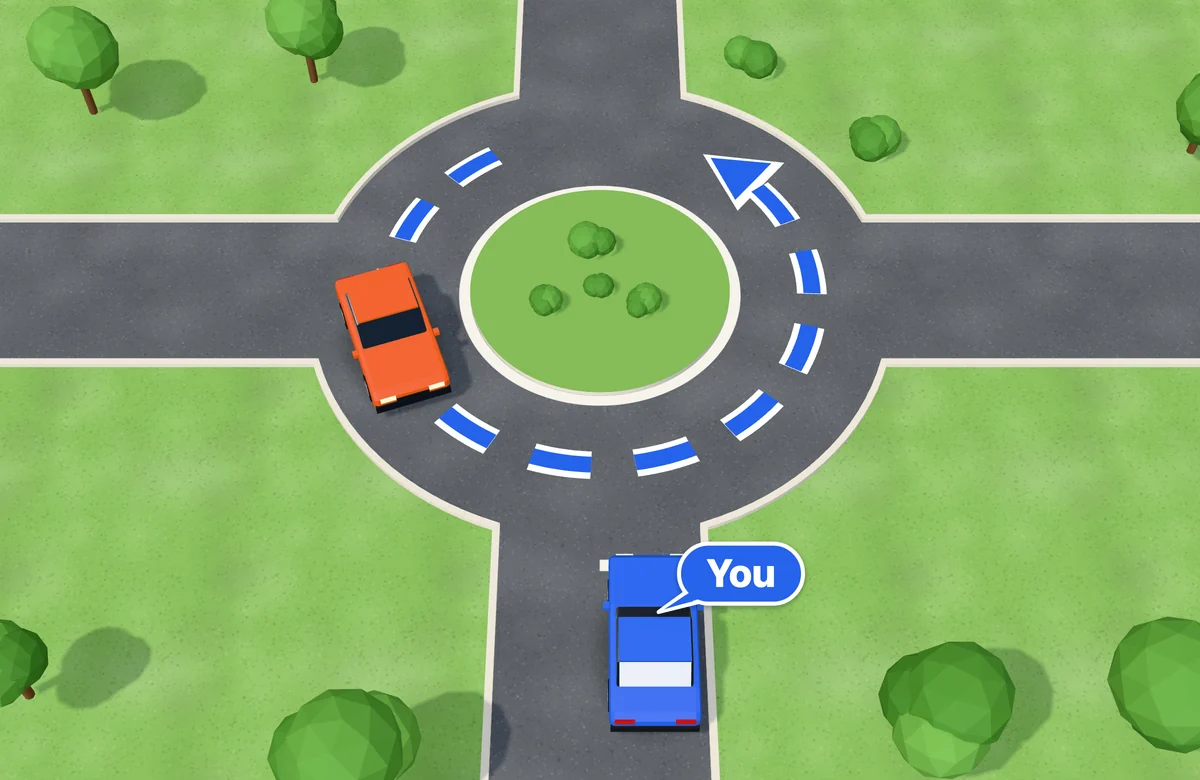
You are about to enter a roundabout. Who has the right-of-way?
- A You, as the entering driver
- B Traffic already in the roundabout
- C Whoever is going straight
- D The vehicle on your right
Show answer
B. Traffic already in the roundabout
Slow down as you approach and yield to all traffic already in the roundabout. Enter to the right when there is a big enough gap and travel counterclockwise without stopping or passing.