California permit test: pavement markings
Yellow and white lines, passing zones, crosswalks, stop lines and special lanes. 5 questions.
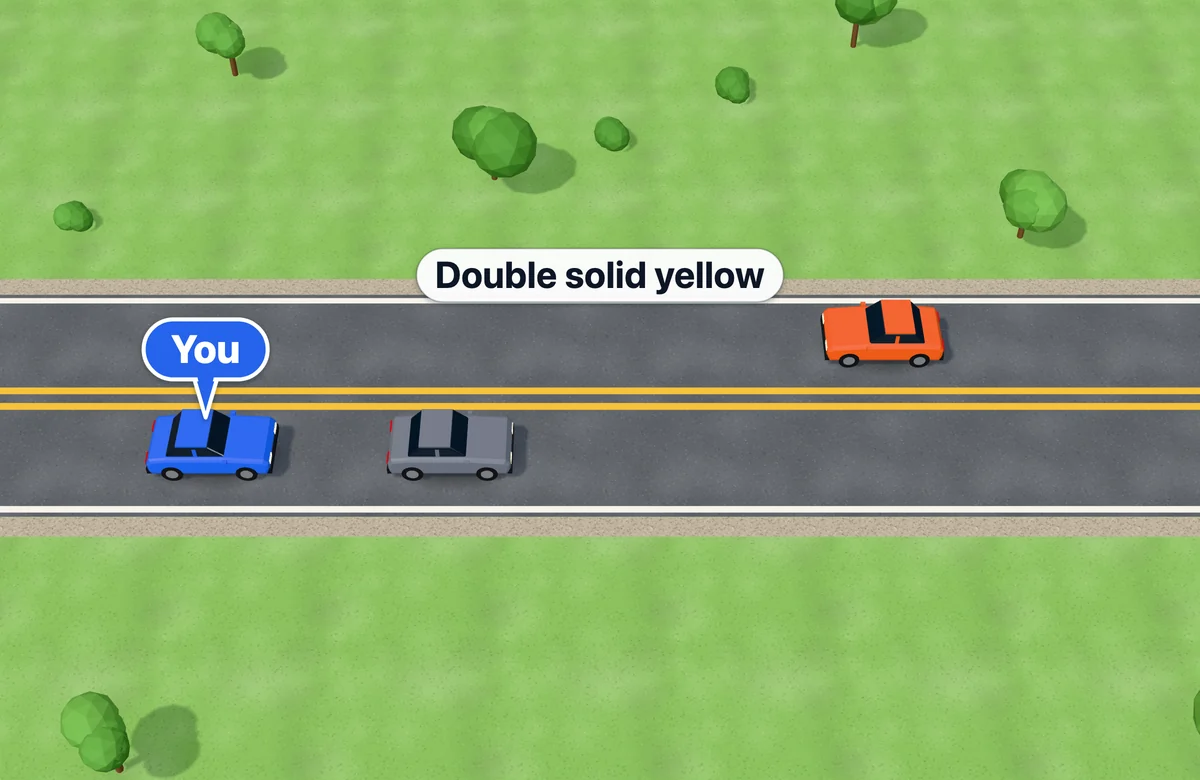
Your lane is separated from oncoming traffic by a single set of double solid yellow lines. When may you cross them?
Keyboard: press 1–4 or A–D to answer, Enter for the next question, S to save, R to read aloud, P to pause reading, L to listen and answer.
Sample pavement markings questions
View diagram
Your lane is separated from oncoming traffic by a single set of double solid yellow lines. When may you cross them?
- A Never; double yellow lines may not be crossed
- B Only to pass a bicyclist in your lane
- C To turn left into a driveway or make a U-turn
- D To pass a slow vehicle when the road ahead is clear
Show answer
C. To turn left into a driveway or make a U-turn
Do not pass over double solid yellow lines. You may cross a single set of them to turn left into or out of a driveway or private road, or to make a U-turn. Two sets spaced two feet or more apart form a barrier you may not cross.
Two sets of double solid yellow lines are painted two or more feet apart. What does this mean?
- A It is a barrier you may not drive over, turn left across, or U-turn across
- B It marks a center lane you may use to turn left within 200 feet
- C You may cross it to turn left into a driveway but not to pass
- D It is a carpool lane that you may enter only at the broken lines
Show answer
A. It is a barrier you may not drive over, turn left across, or U-turn across
Two sets of double yellow lines two or more feet apart are treated as a solid barrier. You may not drive on or over them, turn left, or make a U-turn across them except at designated openings.
Double solid white lines separate your lane from a carpool (HOV) lane. What should you do if you want to enter the HOV lane?
- A Cross only if you are going below the speed limit
- B Cross when the lane next to you is clear
- C Cross after signaling for at least five seconds
- D Wait for a broken white line or designated entrance
Show answer
D. Wait for a broken white line or designated entrance
Double solid white lines are a lane barrier, often between a regular lane and an HOV lane. Never change lanes over them; wait until you reach a single broken white line or a designated entrance.
View diagram
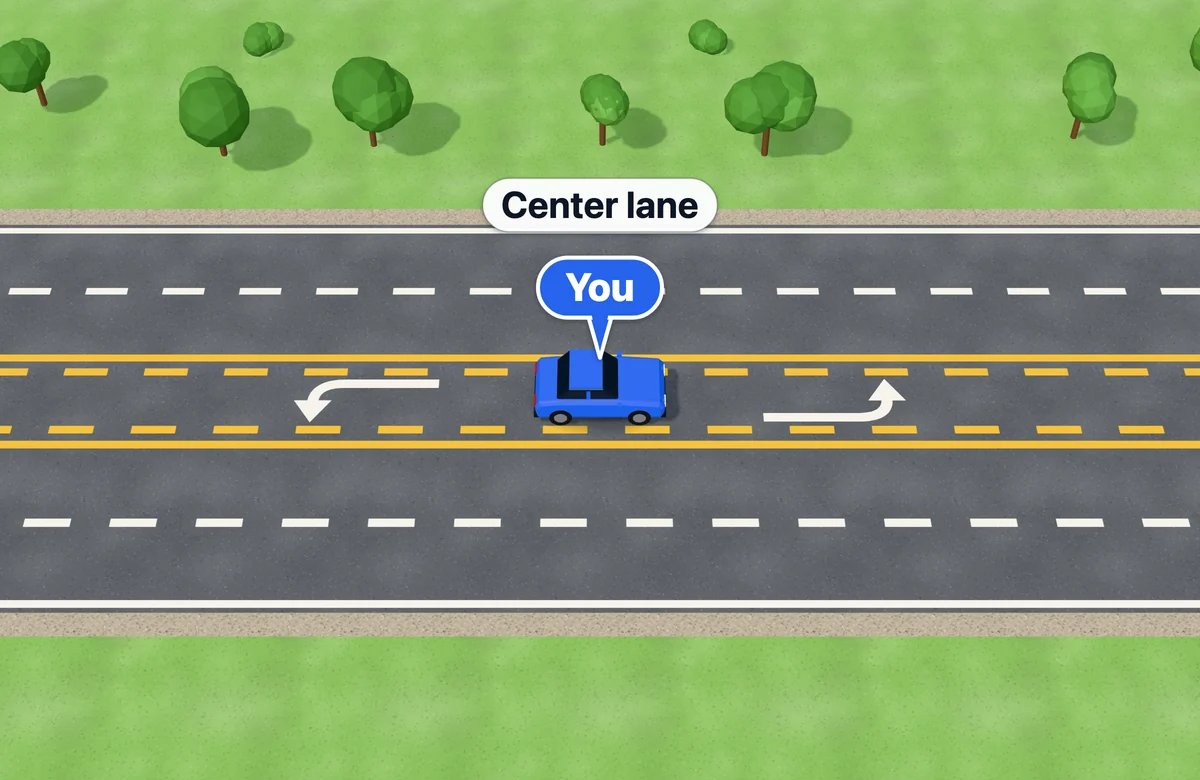
What is the most distance you may drive in a two-way center left turn lane?
- A 100 feet
- B 300 feet
- C 200 feet
- D 500 feet
Show answer
C. 200 feet
A center left turn lane is only for preparing to make a left turn or U-turn, and you may drive in it for no more than 200 feet. It is not a passing or travel lane.