Colorado Permit Practice Test 1
26 questions written from the Colorado Driver Handbook (DR 2337), with an explanation and page citation for every answer.
You are driving in Colorado with an instruction permit. Who must be in the front passenger seat?
Keyboard: press 1–4 or A–D to answer, Enter for the next question, S to save, R to read aloud, P to pause reading, L to listen and answer.
About this test
These questions were written from the Colorado Driver Handbook (DR 2337) (DR 2337). 13 of the 21 Colorado questions in this test cover rules that are specific to Colorado or differ between states. Every answer comes with an explanation and a link to the exact page it comes from, so you can check it yourself.
Your answers are saved in this browser. Questions you miss go to My mistakes so you can practice them again.
Sample questions from this test
You are driving in Colorado with an instruction permit. Who must be in the front passenger seat?
- A A licensed driver 18 or older with at least one year of experience
- B Any adult passenger, seated in front or in back
- C A parent, even one without a driver license
- D A person 21 or older with a valid Colorado license
Show answer
D. A person 21 or older with a valid Colorado license
A Colorado permit holder must have a supervisor who is at least 21 and holds a valid Colorado license, and that person must sit in the front passenger seat. An experienced driver right beside you can coach you and react quickly.
Your brakes suddenly fail. What should you do first?
- A Shift into park while moving
- B Take your foot off the gas and pump the brake pedal
- C Pull the parking brake as hard as you can
- D Shut off the engine right away
Show answer
B. Take your foot off the gas and pump the brake pedal
If your brakes fail, take your foot off the accelerator and pump the brake pedal several times to build pressure. If that fails, apply the parking brake slowly, then shift to lower gears and find a safe place to stop.

View diagram
A solid yellow line and a broken yellow line run side by side, and the solid line is on your side. When may you cross it?
- A Only when the vehicle ahead is under the speed limit
- B To pass any slow vehicle when the road looks clear
- C Never, for any reason
- D To turn left into a driveway or to pass a bicyclist with 3 feet of space when safe
Show answer
D. To turn left into a driveway or to pass a bicyclist with 3 feet of space when safe
You may not pass when the solid yellow is on your side. But you may cross it to turn left into an alley, private road or driveway, or to pass a bicyclist with at least three feet of space when it is safe.
View diagram
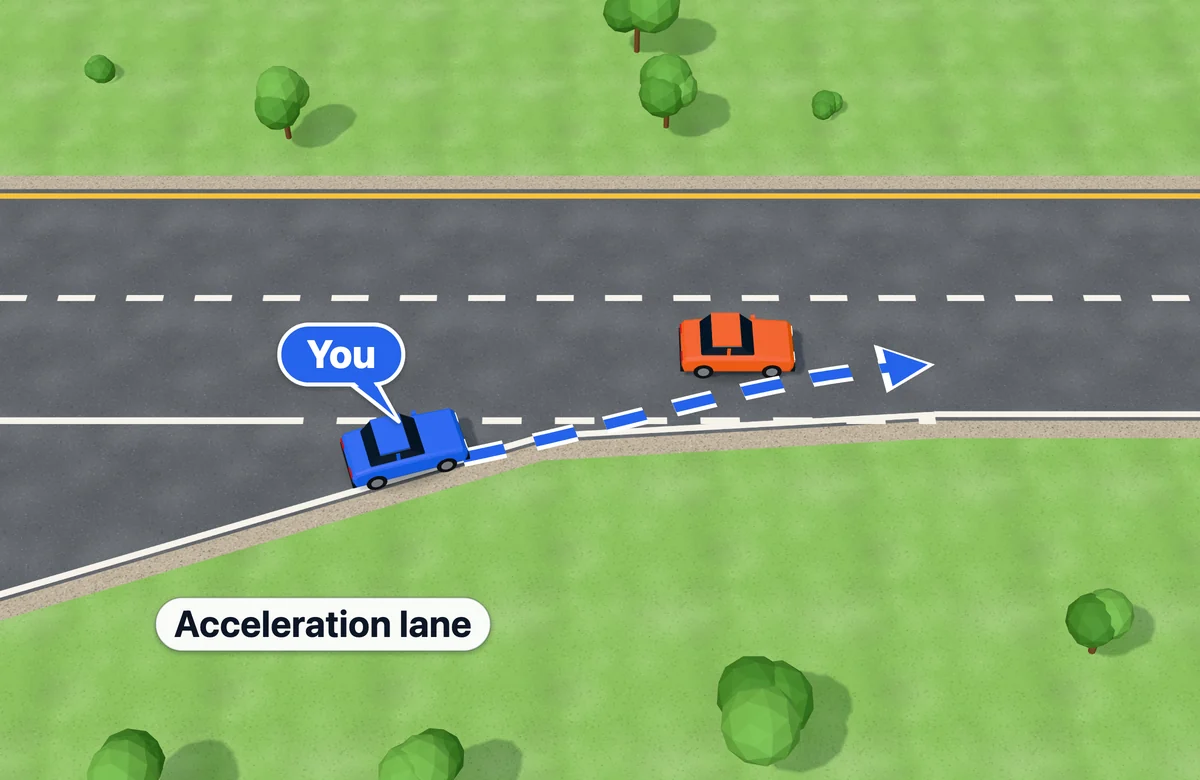
You are in an acceleration lane entering a freeway. When may you merge?
- A As soon as you reach the start of the solid white line
- B Whenever you want, because freeway traffic must yield to merging cars
- C Only after you come to a stop and look
- D After the solid white line has ended, when there is a safe gap
Show answer
D. After the solid white line has ended, when there is a safe gap
Signal, look for an opening, speed up to match traffic and merge when safe, but not until the solid white line has ended. Freeway traffic has the right-of-way.
A 19-year-old is caught buying alcohol while walking, not driving. What can happen to their Colorado driving privilege?
- A It can be revoked even though driving was not involved
- B Nothing, because no vehicle was involved
- C They must retake the written test
- D They get 2 points, but keep their license
Show answer
A. It can be revoked even though driving was not involved
Anyone younger than 21 convicted of buying or possessing alcohol is subject to revocation of their driving privilege, even if driving is not a factor. Colorado ties underage drinking to the license because young drivers are at highest risk.