Colorado Permit Practice Test 3
25 questions written from the Colorado Driver Handbook (DR 2337), with an explanation and page citation for every answer.
When does Colorado law require your headlights to be on?
Keyboard: press 1–4 or A–D to answer, Enter for the next question, S to save, R to read aloud, P to pause reading, L to listen and answer.
About this test
These questions were written from the Colorado Driver Handbook (DR 2337) (DR 2337). 15 of the 20 Colorado questions in this test cover rules that are specific to Colorado or differ between states. Every answer comes with an explanation and a link to the exact page it comes from, so you can check it yourself.
Your answers are saved in this browser. Questions you miss go to My mistakes so you can practice them again.
Sample questions from this test
When does Colorado law require your headlights to be on?
- A Only when it is raining or snowing
- B From sunset to sunrise, or if visibility is under 1,000 feet
- C From sunset to sunrise, or when visibility is under 500 feet
- D Only between midnight and 5 a.m.
Show answer
B. From sunset to sunrise, or if visibility is under 1,000 feet
Colorado requires headlights from sunset to sunrise or when visibility is less than 1,000 feet. Driving with low beams on at all times is a good way to be seen.
In Colorado, how close to a fire hydrant may you park?
- A No closer than 5 feet
- B No closer than 15 feet
- C No closer than 30 feet
- D No closer than 10 feet
Show answer
B. No closer than 15 feet
You may not park within 15 feet of a fire hydrant. Firefighters need clear access to connect hoses quickly.
In Colorado, when is passing on the right allowed?
- A On the paved shoulder of a two-lane road
- B On a two-lane road, whenever the driver ahead is below the limit
- C Whenever the left lane is blocked
- D On one-way streets or roads with 2+ lanes each way
Show answer
D. On one-way streets or roads with 2+ lanes each way
You should usually pass on the left. Passing on the right is allowed only on one-way streets and roads with two or more lanes each way. Never pass by driving onto the shoulder or off the pavement.
What happens to fines for speeding in a Colorado work zone?
- A They can be doubled
- B They are the same as anywhere else
- C They drop to a warning for a first offense
- D They are tripled
Show answer
A. They can be doubled
Failing to follow the speed limit in a work or construction zone can result in double fines. Like school zones, work zones carry higher fines to protect workers.
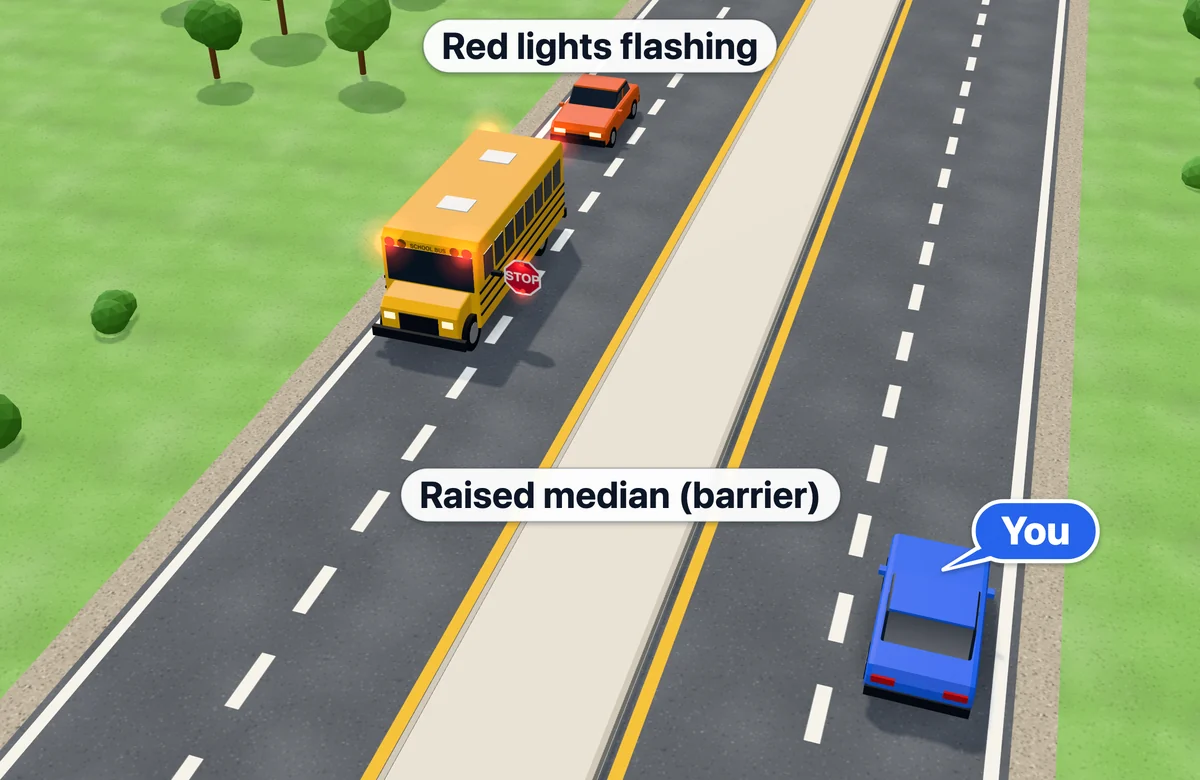
View diagram
A school bus with flashing red lights is stopped on the other side of a divided highway with a median. Must you stop?
- A Only if you are in the left lane
- B Yes, all traffic in every direction must stop for a school bus
- C Yes, but only if children are visible
- D No, because a median or barrier separates you from the bus
Show answer
D. No, because a median or barrier separates you from the bus
You must stop for a school bus with flashing red lights whether it is on your side, the opposite side or at an intersection, unless a median or physical barrier separates the bus from your vehicle. Still watch for children.