Florida Permit Practice Test 2
25 questions written from the The Official Florida Driver License Handbook (Florida Class E Driver License Handbook), with an explanation and page citation for every answer.
What insurance must every Florida vehicle owner carry at minimum?
Keyboard: press 1–4 or A–D to answer, Enter for the next question, S to save, R to read aloud, P to pause reading, L to listen and answer.
About this test
These questions were written from the The Official Florida Driver License Handbook (Florida Class E Driver License Handbook) (rev. 08/2023). 12 of the 20 Florida questions in this test cover rules that are specific to Florida or differ between states. Every answer comes with an explanation and a link to the exact page it comes from, so you can check it yourself.
Your answers are saved in this browser. Questions you miss go to My mistakes so you can practice them again.
Sample questions from this test
What insurance must every Florida vehicle owner carry at minimum?
- A $10,000 PIP and $10,000 property damage liability
- B $10,000 PIP and $20,000 bodily injury liability
- C $25,000 bodily injury and $10,000 property damage
- D $5,000 PIP and $5,000 property damage liability
Show answer
A. $10,000 PIP and $10,000 property damage liability
Florida's No-Fault Law requires at least $10,000 in Personal Injury Protection (PIP) and $10,000 in Property Damage Liability (PDL). PIP pays for your own injuries no matter who caused the crash.
Source: The Official Florida Driver License Handbook (Florida Class E Driver License Handbook), page 31
View diagram
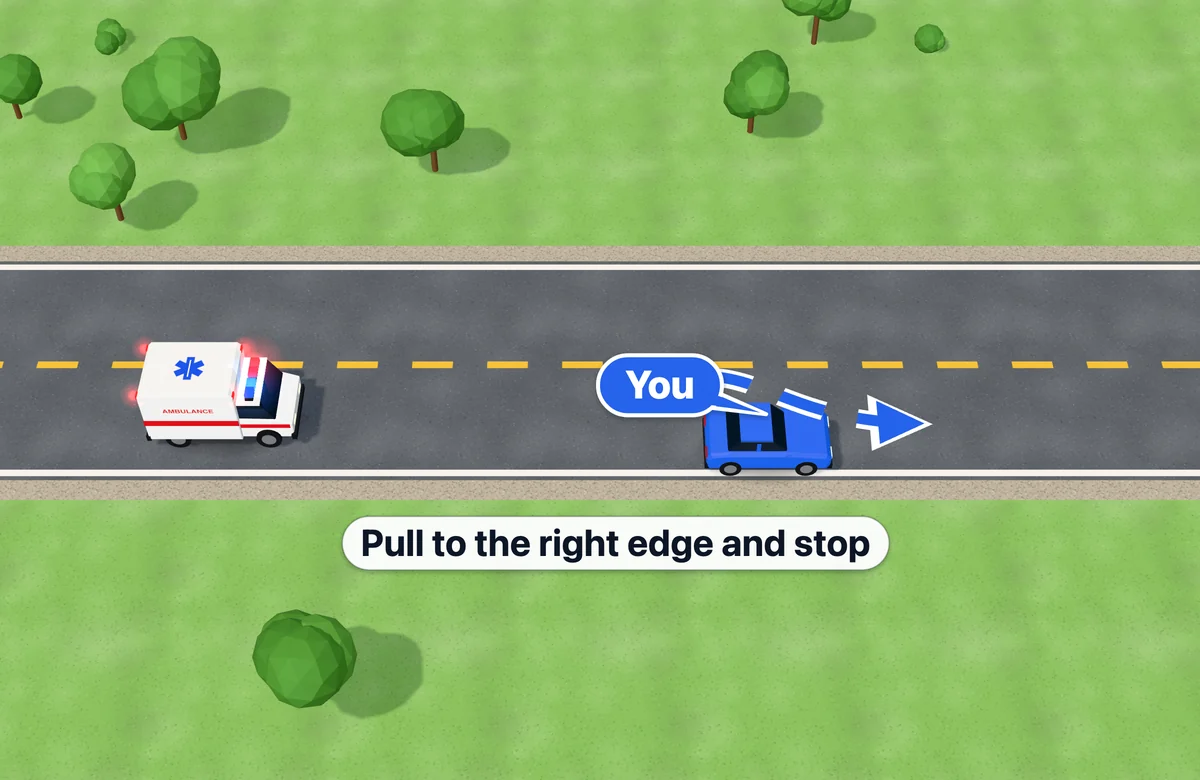
An ambulance with flashing lights and a siren is coming up behind you. What should you do?
- A Pull over to the nearest edge of the road and stop
- B Speed up to stay ahead of the ambulance
- C Stop right where you are in your lane
- D Keep driving but move to the left lane
Show answer
A. Pull over to the nearest edge of the road and stop
Yield to emergency vehicles using sirens or flashing lights by pulling over to the closest edge of the roadway and stopping until they pass. Do not block intersections.
Source: The Official Florida Driver License Handbook (Florida Class E Driver License Handbook), page 92
How far before a turn must you signal in Florida?
- A At least 100 feet
- B At least 50 feet
- C At least 200 feet
- D Just as you begin turning
Show answer
A. At least 100 feet
You must signal at least 100 feet before turning. Signaling early gives drivers, bicyclists and pedestrians time to see what you plan to do.
Source: The Official Florida Driver License Handbook (Florida Class E Driver License Handbook), page 77
View diagram
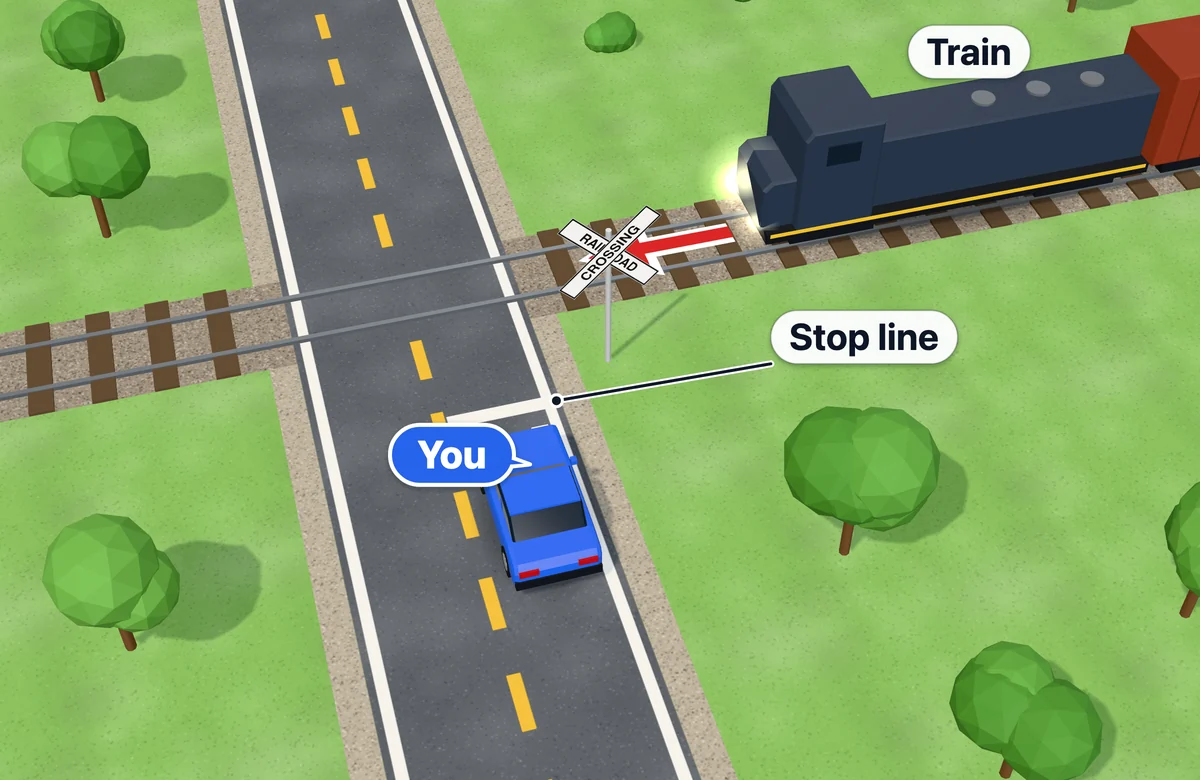
When you stop for a train at a railroad crossing, how close to the crossing may you stop?
- A No closer than 5 feet
- B No closer than 10 feet
- C No closer than 15 feet
- D No closer than 50 feet
Show answer
C. No closer than 15 feet
Never stop on the tracks or within 15 feet of a crossing. Trains are wider than the rails and can strike anything too close.
Source: The Official Florida Driver License Handbook (Florida Class E Driver License Handbook), page 64
A 16-year-old passenger in the back seat is not wearing a safety belt. Who will be charged?
- A The 16-year-old passenger
- B The passenger's parent or guardian
- C No one, because back-seat belts are optional
- D The driver
Show answer
D. The driver
The driver is charged if any passenger under 18 is not properly restrained. Passengers 18 and older are charged themselves when the law requires them to wear a belt, such as in the front seat. As the driver, check that young passengers are buckled before you move.
Source: The Official Florida Driver License Handbook (Florida Class E Driver License Handbook), page 36