Florida Permit Practice Test 5
25 questions written from the The Official Florida Driver License Handbook (Florida Class E Driver License Handbook), with an explanation and page citation for every answer.
Under Florida law, who in a car must wear a safety belt?
Keyboard: press 1–4 or A–D to answer, Enter for the next question, S to save, R to read aloud, P to pause reading, L to listen and answer.
About this test
These questions were written from the The Official Florida Driver License Handbook (Florida Class E Driver License Handbook) (rev. 08/2023). 13 of the 20 Florida questions in this test cover rules that are specific to Florida or differ between states. Every answer comes with an explanation and a link to the exact page it comes from, so you can check it yourself.
Your answers are saved in this browser. Questions you miss go to My mistakes so you can practice them again.
Sample questions from this test
Under Florida law, who in a car must wear a safety belt?
- A The driver, front-seat passengers and passengers under 18
- B Only the driver and anyone riding in the front seat
- C Only passengers who are under 18 years of age
- D Only the driver, since passengers make their own choice
Show answer
A. The driver, front-seat passengers and passengers under 18
Florida requires safety belts for all drivers, all front-seat passengers and all passengers under 18. Belts keep you from being thrown from the car and keep the driver in control.
Source: The Official Florida Driver License Handbook (Florida Class E Driver License Handbook), page 36
View diagram
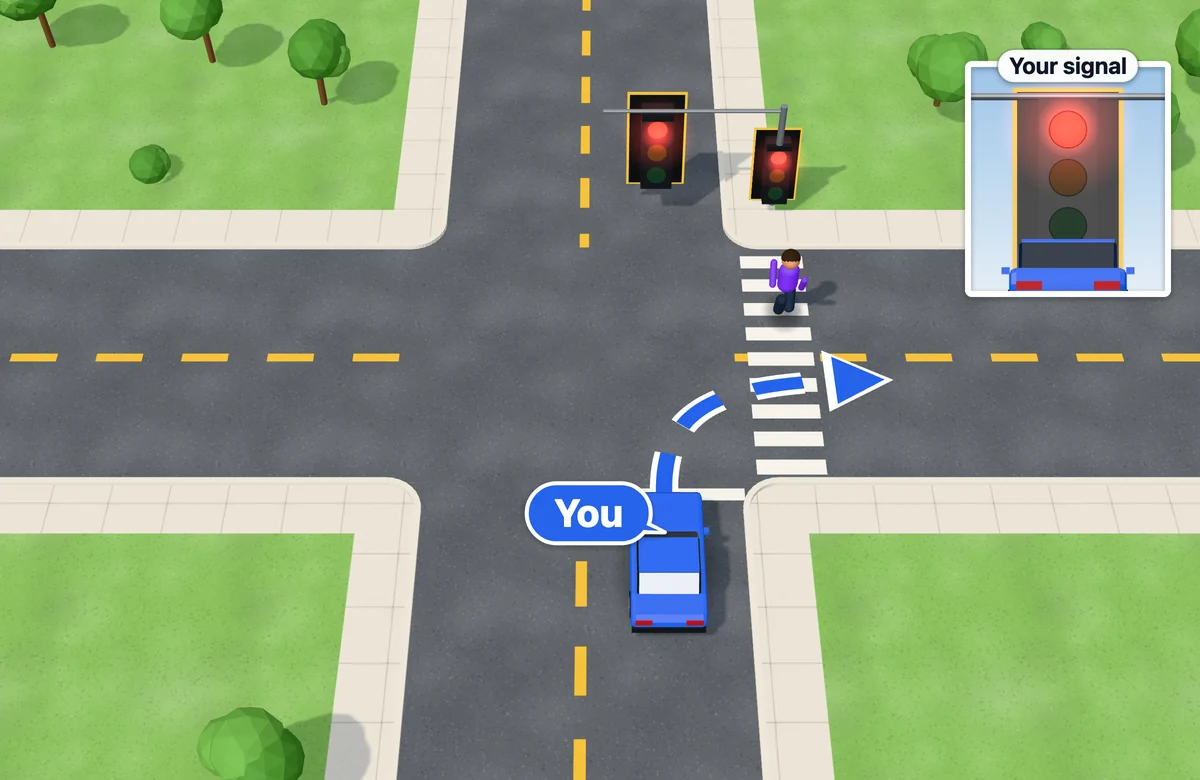
You are stopped at a steady red light. There is no sign forbidding it. What may you do?
- A Turn right once the way is clear
- B Go straight if no cross traffic is coming
- C Turn right without stopping if it is clear
- D Turn left onto any two-way street
Show answer
A. Turn right once the way is clear
After a complete stop at a red light, you may turn right unless a NO TURN ON RED sign is posted, as long as the way is clear. You must still yield to pedestrians in the crosswalk and to other traffic.
Source: The Official Florida Driver License Handbook (Florida Class E Driver License Handbook), page 59

View diagram
What minimum following distance does Florida's handbook recommend in good weather and traffic?
- A 2 seconds
- B 1 second
- C 4 seconds
- D 6 seconds
Show answer
C. 4 seconds
Keep at least four seconds between you and the vehicle ahead in favorable conditions, and more in bad weather or heavy traffic. Count from when the car ahead passes a fixed object until you reach it.
Source: The Official Florida Driver License Handbook (Florida Class E Driver License Handbook), page 69
Your car has been in Florida for a total of 90 days over the past year, though not all in a row. What does Florida insurance law require?
- A Nothing until the car has been here six months in a row
- B Only a Florida driver license, with no insurance change
- C Coverage only if the 90 days were all consecutive
- D You must carry Florida PIP and PDL coverage
Show answer
D. You must carry Florida PIP and PDL coverage
If you own a vehicle that has been in Florida for 90 days, consecutive or not, within the last 365 days, you must meet the No-Fault insurance requirements. The rule keeps part-time residents from driving uninsured.
Source: The Official Florida Driver License Handbook (Florida Class E Driver License Handbook), page 31
On a multi-lane highway you approach a police car stopped on the shoulder with lights flashing, but you cannot safely change lanes. What does the Move Over Law require?
- A Slow to 10 MPH below the posted speed limit
- B Slow to 20 MPH below the posted speed limit
- C Stop until the officer waves you on
- D Keep your speed but use your hazard lights
Show answer
B. Slow to 20 MPH below the posted speed limit
On a multi-lane road you must leave the lane closest to the stopped emergency, tow, sanitation or utility vehicle. If you cannot move over safely, slow to 20 MPH below the posted limit.
Source: The Official Florida Driver License Handbook (Florida Class E Driver License Handbook), page 73