North Carolina permit test: railroad crossings
Crossing signs and signals, when to stop and what to do if stuck. 4 questions.
A railroad crossing signal is flashing to warn of a train. Where does North Carolina law require you to stop?
Keyboard: press 1–4 or A–D to answer, Enter for the next question, S to save, R to read aloud, P to pause reading, L to listen and answer.
Sample railroad crossings questions
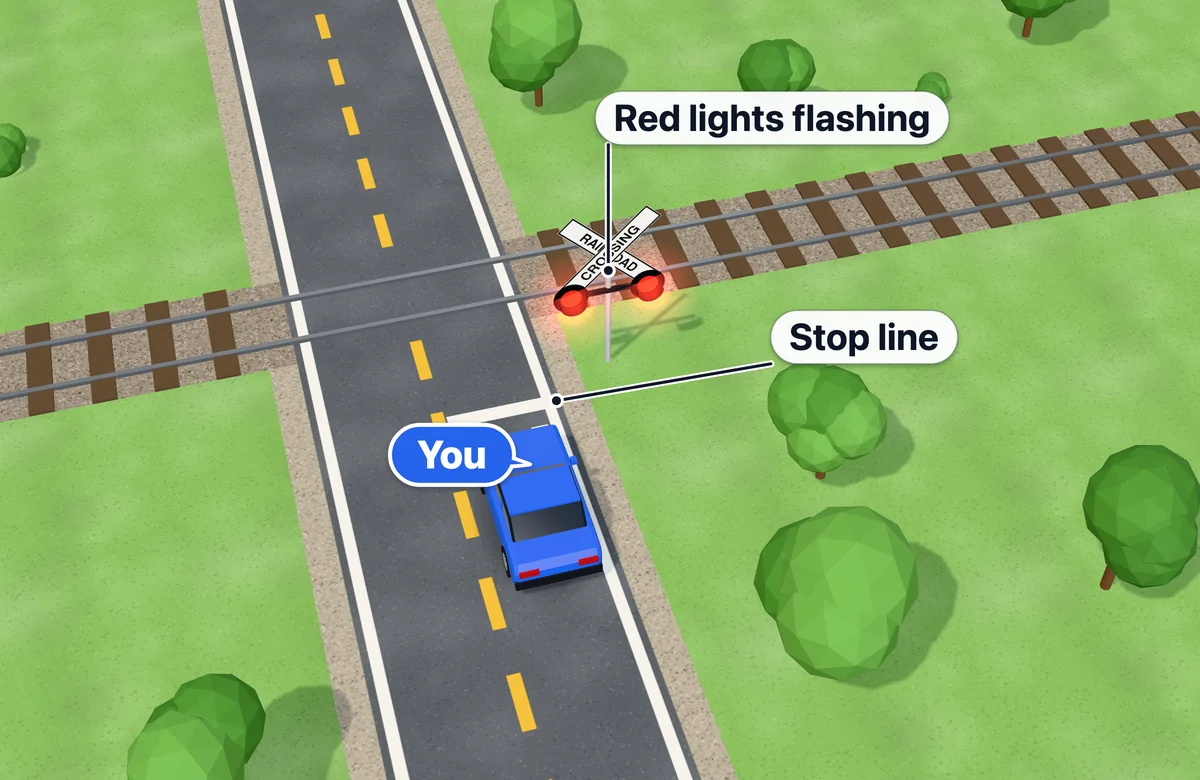
View diagram
A railroad crossing signal is flashing to warn of a train. Where does North Carolina law require you to stop?
- A Between 15 and 50 feet from the nearest rail
- B Between 50 and 100 feet from the nearest rail
- C Between 5 and 15 feet from the nearest rail
- D Right at the crossing gate, on the tracks if needed
Show answer
A. Between 15 and 50 feet from the nearest rail
When a signal, gate, flagger or approaching train requires it, you must stop within 50 feet but not less than 15 feet from the nearest rail. Do not go until it is safe.
Your car stalls on railroad tracks. After getting everyone out and away, how should you report it?
- A Call the DMV customer service number
- B Wait in the car for the train crew to notice it
- C Stand on the tracks and wave at the train
- D Call the number on the blue Emergency Notification System sign
Show answer
D. Call the number on the blue Emergency Notification System sign
Every North Carolina crossing has a blue Emergency Notification System sign with the crossing ID and the railroad's emergency number. Calling it is the fastest way to stop a train.
You are already crossing the tracks when the warning lights start flashing and the gates begin to lower. What should you do?
- A Get out of the car and run
- B Stop and back up off the tracks
- C Stop on the tracks and wait for the gates to rise
- D Keep moving until you are across the tracks
Show answer
D. Keep moving until you are across the tracks
If the lights begin flashing or the gates start down while you are crossing, do not stop and do not back up: keep moving. The signals give enough time to clear, and the gates are flexible, so they cannot trap you.
A train has just passed a crossing where you are waiting. Why should you not drive across right away?
- A You must wait for a railroad worker's signal
- B The law sets a fixed one-minute wait after every train
- C Another train may be coming on another track
- D The train's wind blast can push your car off the road
Show answer
C. Another train may be coming on another track
Do not move as soon as a train has passed. A second train may be coming from the other direction or following the first. Wait until the red lights stop flashing and look both ways.