North Carolina permit test: turning & signaling
Turn lanes, turn signals, hand signals, U-turns and turns on red. 5 questions.
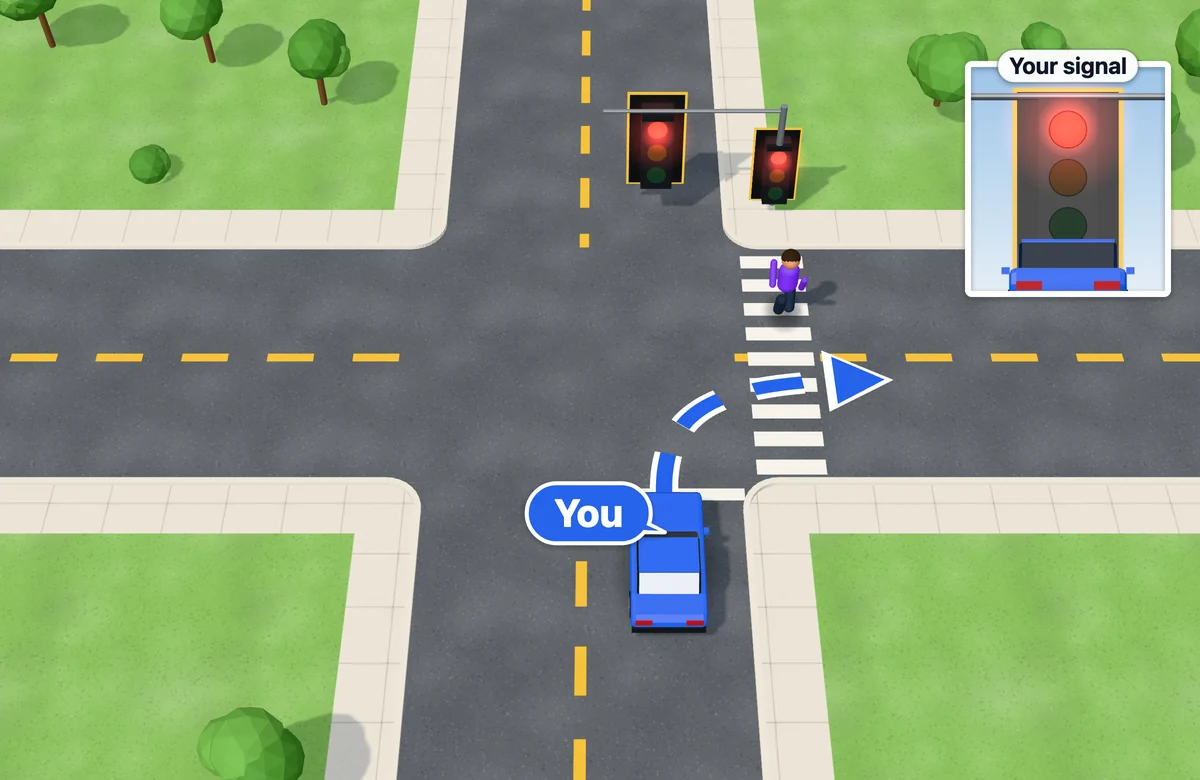
You are stopped at a steady red light and there is no NO TURN ON RED sign. What may you do?
Keyboard: press 1–4 or A–D to answer, Enter for the next question, S to save, R to read aloud, P to pause reading, L to listen and answer.
Sample turning & signaling questions
View diagram
You are stopped at a steady red light and there is no NO TURN ON RED sign. What may you do?
- A Turn right after a complete stop, yielding to others
- B Turn either left or right after coming to a complete stop
- C Nothing; you must wait for the green light
- D Turn right without stopping if the way is clear
Show answer
A. Turn right after a complete stop, yielding to others
Unless a sign says NO TURN ON RED, you may turn right on a steady red after coming to a complete stop. You must yield to other traffic and to pedestrians using or starting to cross the intersection.
While turning right on red, a driver fails to yield to a pedestrian starting to cross in front of them. What is the penalty?
- A Not less than $25 and not more than $100
- B A warning on the first offense
- C Not less than $250 and not more than $1,000
- D Not less than $100 and not more than $500
Show answer
D. Not less than $100 and not more than $500
North Carolina sets a penalty of $100 to $500 for failing to yield to pedestrians while turning right on red. Pedestrians often step out as the light changes, so check the crosswalk before turning.
You plan to turn on a road where the speed limit is 50 mph. How far ahead must you signal?
- A At least the last 300 feet
- B At least the last 100 feet
- C At least the last 200 feet
- D At least the last 50 feet
Show answer
C. At least the last 200 feet
Signal at least the last 100 feet before turning or stopping, and at least the last 200 feet when the speed limit is 45 mph or more. Faster traffic needs more warning, so signal earlier as speed rises.
How do you signal a right turn by hand?
- A Left arm down, palm facing back
- B Left arm held straight out, pointing with your first finger
- C Left arm out, forearm and hand pointing up, palm forward
- D Right arm out the passenger window
Show answer
C. Left arm out, forearm and hand pointing up, palm forward
Hand signals use the left arm from the driver's window. For a right turn, hold the arm out with the forearm and hand straight up, palm forward. Straight out means left, and down means slow or stop.