Ohio Permit Practice Test 2
26 questions written from the Ohio Driver Manual - Digest of Ohio Motor Vehicle Laws, with an explanation and page citation for every answer.
What are Ohio's minimum liability insurance amounts?
Keyboard: press 1–4 or A–D to answer, Enter for the next question, S to save, R to read aloud, P to pause reading, L to listen and answer.
About this test
These questions were written from the Ohio Driver Manual - Digest of Ohio Motor Vehicle Laws (Web edition; sections dated January 26, 2024). 12 of the 21 Ohio questions in this test cover rules that are specific to Ohio or differ between states. Every answer comes with an explanation and a link to the exact page it comes from, so you can check it yourself.
Your answers are saved in this browser. Questions you miss go to My mistakes so you can practice them again.
Sample questions from this test
What are Ohio's minimum liability insurance amounts?
- A $25,000 per person, $50,000 per crash for injury, $25,000 property
- B $15,000 per person, $30,000 per crash for injury, $5,000 property
- C $50,000 per person, $100,000 per crash for injury, $25,000 property
- D $25,000 per person, $50,000 per crash for injury, $10,000 property
Show answer
A. $25,000 per person, $50,000 per crash for injury, $25,000 property
Ohio requires at least $25,000 for injury or death of one person, $50,000 for injury or death of two or more people, and $25,000 for property damage. These minimums make sure drivers can pay for harm they cause.
Source: Ohio Driver Manual - Digest of Ohio Motor Vehicle Laws, section 6
Under Ohio law, what must your speed allow you to do, regardless of the posted limit?
- A Keep up with the fastest traffic
- B Reach the next signal before it turns red
- C Stop within the distance available ahead
- D Stay exactly at the posted limit
Show answer
C. Stop within the distance available ahead
Ohio prohibits driving faster than allows you to stop in the distance available, known as the assured clear distance ahead. In rain, heavy traffic, or poor visibility, a reasonable speed may be below the limit.
Source: Ohio Driver Manual - Digest of Ohio Motor Vehicle Laws, section 4
When parallel parking on a two-way street in Ohio, how close must your wheels be to the right curb?
- A No more than 18 inches
- B No more than 12 inches
- C No more than 6 inches
- D No more than 24 inches
Show answer
B. No more than 12 inches
Park facing the direction of traffic, parallel to and no more than 12 inches from the right curb. On one-way streets, you may park within 12 inches of either curb.
Source: Ohio Driver Manual - Digest of Ohio Motor Vehicle Laws, section 5
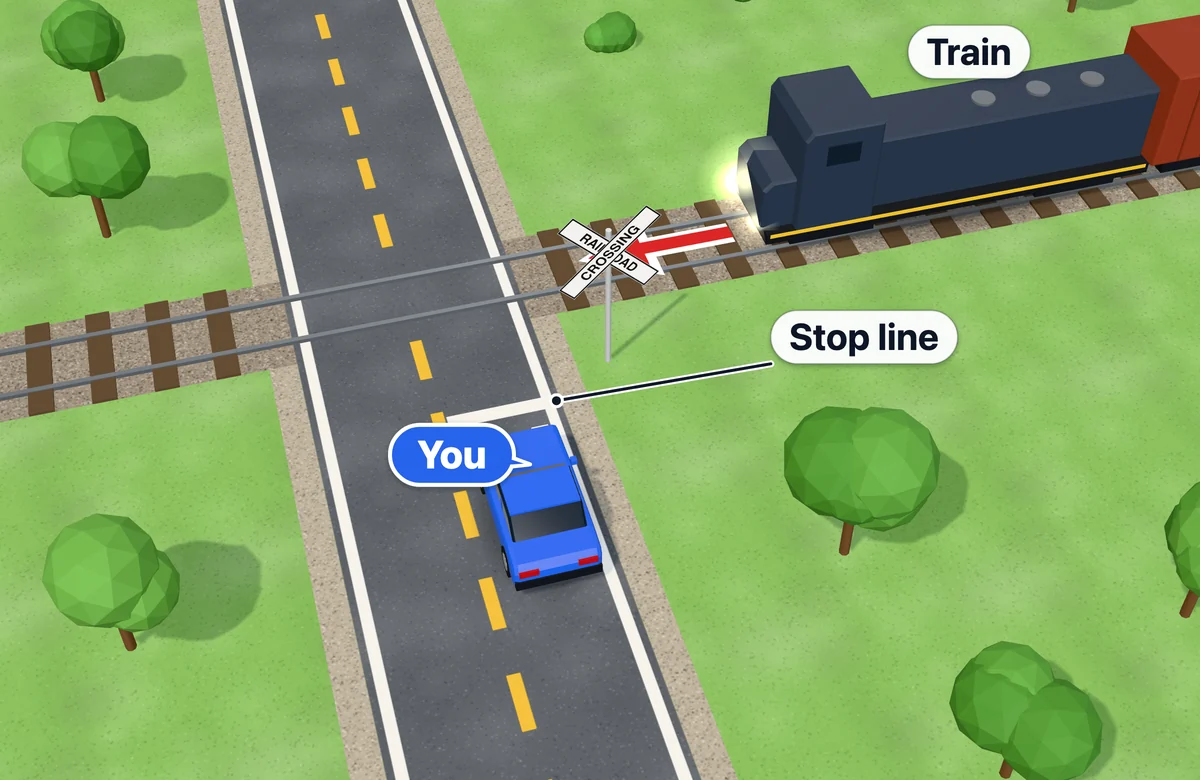
View diagram
A train is approaching a crossing. Where must you stop?
- A No closer than 5 feet and no farther than 25 feet
- B No closer than 15 feet and no farther than 50 feet from the crossing
- C No closer than 20 feet and no farther than 100 feet
- D Right at the edge of the first rail
Show answer
B. No closer than 15 feet and no farther than 50 feet from the crossing
When a train is approaching, stop no closer than 15 feet and no farther than 50 feet from the crossing. Wait until the train passes and all signals stop before crossing.
Source: Ohio Driver Manual - Digest of Ohio Motor Vehicle Laws, section 5
How much lane space should you give a motorcyclist?
- A Half a lane, so you can share it
- B A full lane width
- C Only the right third of the lane
- D No special space; treat it like a bicycle
Show answer
B. A full lane width
Give a motorcyclist a full lane width, the same as any other vehicle. The rider needs room to react to other traffic and to avoid road hazards.
Source: Ohio Driver Manual - Digest of Ohio Motor Vehicle Laws, section 9