Ohio Permit Practice Test 4
25 questions written from the Ohio Driver Manual - Digest of Ohio Motor Vehicle Laws, with an explanation and page citation for every answer.
In Ohio, what blood alcohol concentration (BAC) makes it illegal for an adult 21 or older to drive a regular car?
Keyboard: press 1–4 or A–D to answer, Enter for the next question, S to save, R to read aloud, P to pause reading, L to listen and answer.
About this test
These questions were written from the Ohio Driver Manual - Digest of Ohio Motor Vehicle Laws (Web edition; sections dated January 26, 2024). 13 of the 20 Ohio questions in this test cover rules that are specific to Ohio or differ between states. Every answer comes with an explanation and a link to the exact page it comes from, so you can check it yourself.
Your answers are saved in this browser. Questions you miss go to My mistakes so you can practice them again.
Sample questions from this test
In Ohio, what blood alcohol concentration (BAC) makes it illegal for an adult 21 or older to drive a regular car?
- A 0.08% or higher
- B 0.10% or higher
- C 0.05% or higher
- D 0.04% or higher
Show answer
A. 0.08% or higher
Ohio makes it illegal for anyone to drive with a BAC of 0.08% or higher. Lower limits apply to commercial drivers (0.04%) and to drivers under 21 (0.02%). You can be impaired even below these numbers.
Source: Ohio Driver Manual - Digest of Ohio Motor Vehicle Laws, section 6
When are headlights required in Ohio besides between sunset and sunrise?
- A Whenever you can't see objects 500 feet ahead
- B Only when it is snowing heavily
- C Only on highways at night
- D Whenever you can't clearly see objects 1,000 feet ahead
Show answer
D. Whenever you can't clearly see objects 1,000 feet ahead
Ohio requires lights between sunset and sunrise, during rain, snow, fog, or other bad weather, whenever natural light doesn't let you clearly see objects 1,000 feet ahead, and whenever wipers are in use because of precipitation.
Source: Ohio Driver Manual - Digest of Ohio Motor Vehicle Laws, section 7
What do white lane lines separate?
- A Traffic traveling in opposite directions
- B Parking spaces from bike lanes only
- C Passing zones from no-passing zones
- D Traffic traveling in the same direction
Show answer
D. Traffic traveling in the same direction
White lines separate lanes of traffic moving in the same direction and may be solid or broken. Yellow lines separate traffic moving in opposite directions.
Source: Ohio Driver Manual - Digest of Ohio Motor Vehicle Laws, section 4
How many questions are on the Ohio knowledge test, and what share must you get right?
- A 40 questions, with 75% needed to pass
- B 50 questions, with 80% needed to pass
- C 40 questions, with 80% needed to pass
- D 30 questions, with 70% needed to pass
Show answer
A. 40 questions, with 75% needed to pass
Ohio's knowledge test has 40 multiple-choice questions and you need 75% to pass, which means at least 30 correct answers. Knowing the format helps you pace your study.
Source: Ohio Driver Manual - Digest of Ohio Motor Vehicle Laws, section 1
View diagram
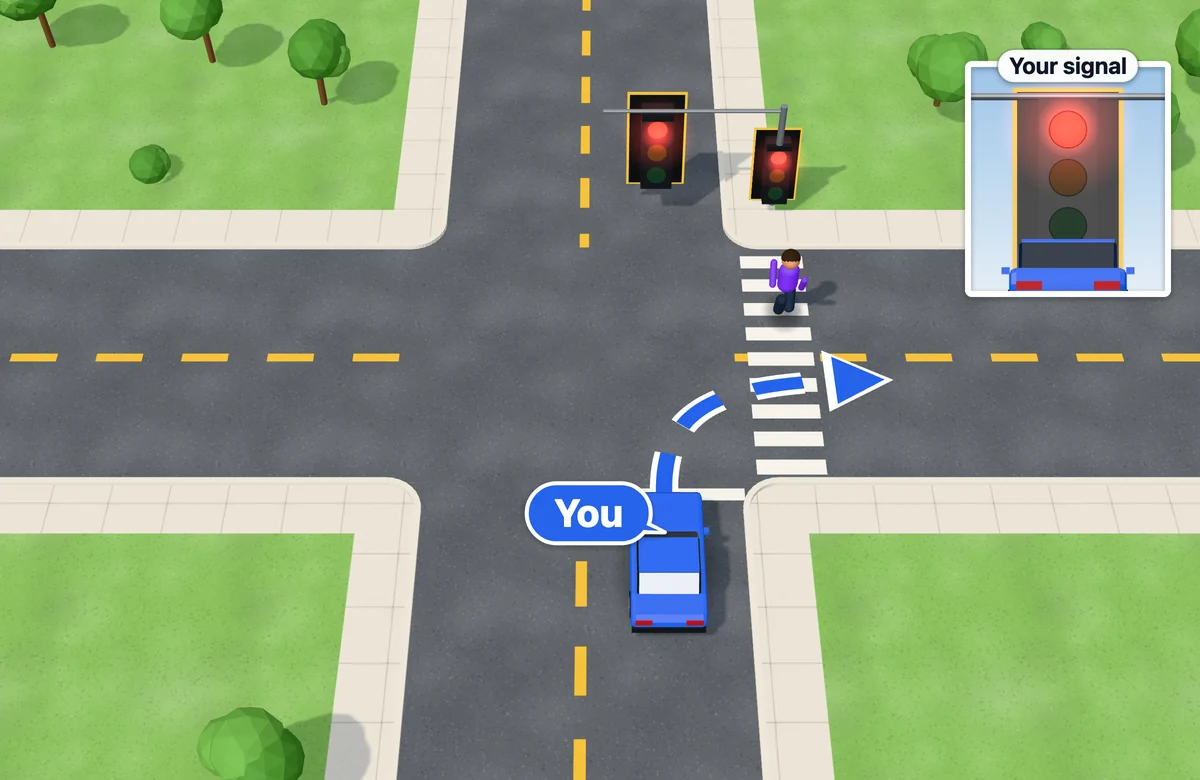
You want to turn right on red in Ohio and no sign forbids it. What must you do first?
- A Slow down and turn if no cars are coming
- B Stop completely and let crossing traffic and pedestrians clear
- C Wait for the light to turn green
- D Honk, then turn if pedestrians stop
Show answer
B. Stop completely and let crossing traffic and pedestrians clear
Ohio allows right turns on red unless a sign prohibits it. Come to a complete stop and allow all crossing traffic and pedestrians to clear the intersection before turning.
Source: Ohio Driver Manual - Digest of Ohio Motor Vehicle Laws, section 5