West Virginia permit test: parking & stopping
Where you may not park, distances from hydrants and crossings, curbs and hills. 8 questions.
When parallel parking on a two-way street, how close to the right curb must your wheels be?
Keyboard: press 1–4 or A–D to answer, Enter for the next question, S to save, R to read aloud, P to pause reading, L to listen and answer.
Sample parking & stopping questions
When parallel parking on a two-way street, how close to the right curb must your wheels be?
- A Within 18 inches
- B Within 12 inches
- C Within 24 inches
- D Within 36 inches
Show answer
A. Within 18 inches
West Virginia requires your right-hand wheels to be parallel to and within 18 inches of the right curb. Park in the direction of traffic and center the car in the space.
You parallel park on the left side of a one-way street. Where should your wheels be?
- A Within 18 inches of the right curb
- B Within 12 inches of the left curb
- C Anywhere in the parking lane
- D Within 18 inches of the left curb
Show answer
D. Within 18 inches of the left curb
When parallel parking on the left side of the road, keep your wheels within 18 inches of the left curb. Always park facing the direction of traffic.
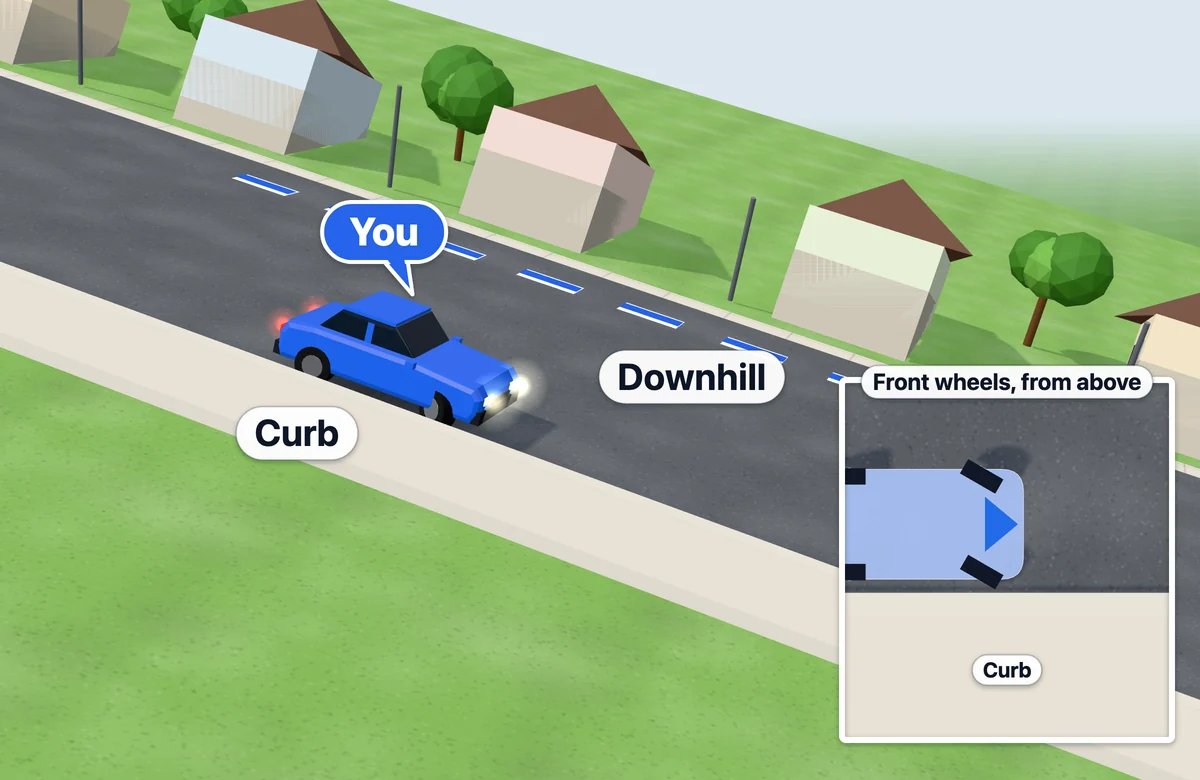
View diagram
You park facing downhill next to a curb. Which way should you turn your front wheels?
- A Away from the curb
- B Toward the curb
- C Straight ahead
- D It does not matter with the brake set
Show answer
B. Toward the curb
When you park on a grade, turn the front wheels toward the curb side so the vehicle will not roll, and set the parking brake. Facing downhill, the curb then stops the car if it moves.
You park a manual-transmission car facing downhill. Which gear helps reinforce the parking brake?
- A Reverse
- B First gear
- C Neutral
- D Third gear
Show answer
A. Reverse
To back up the parking brake, use reverse on a downgrade or first gear on an upgrade in a manual car. In an automatic, put the selector in park.