West Virginia permit test: sharing the road
Pedestrians, bicyclists, motorcyclists, trucks, buses and slow vehicles. 6 questions.
How much of the lane is a motorcyclist entitled to use?
Keyboard: press 1–4 or A–D to answer, Enter for the next question, S to save, R to read aloud, P to pause reading, L to listen and answer.
Sample sharing the road questions
How much of the lane is a motorcyclist entitled to use?
- A Only the right half
- B The entire lane
- C Only the left third
- D Whatever space cars leave
Show answer
B. The entire lane
Motorcyclists are entitled to and need the entire lane to move around hazards. Never squeeze into a motorcyclist's lane to pass.
A triangular emblem on the back of a vehicle means what?
- A It is carrying hazardous materials
- B It is a school vehicle
- C It is a slow-moving vehicle
- D It is an oversize load
Show answer
C. It is a slow-moving vehicle
Slow-moving vehicles such as farm equipment and construction machines must show a special triangular emblem. When you see it, slow down early and pass only when it is safe.
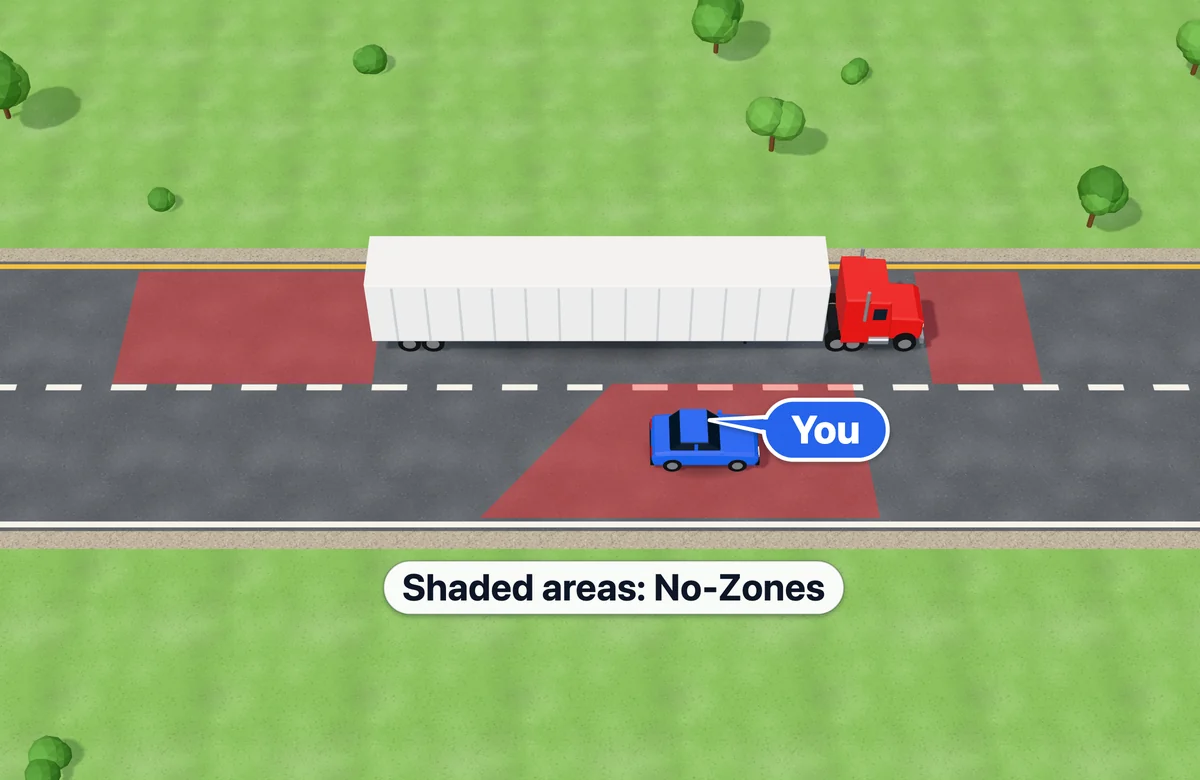
View diagram
How can you tell if you are in a truck driver's blind spot (the No-Zone)?
- A The truck's turn signal is flashing
- B You are following more than 100 feet behind the trailer
- C You cannot see the driver's reflection in the side mirror
- D The truck is going uphill
Show answer
C. You cannot see the driver's reflection in the side mirror
If you cannot see the truck driver's reflection in the side mirror, the driver cannot see you. Do not linger in the No-Zone longer than needed to pass.
In wet conditions, how much space should you leave behind a large truck?
- A Two seconds
- B At least four to six seconds
- C One car length
- D Three seconds
Show answer
B. At least four to six seconds
In wet conditions give trucks at least four to six seconds of space. Trucks need more distance to stop, and spray from their tires cuts your view.