California Permit Practice Test 3
25 questions written from the California Driver's Handbook (DL 600), with an explanation and page citation for every answer.
If you are 21 or older, at what blood alcohol concentration (BAC) is it illegal to drive a regular car in California?
Keyboard: press 1–4 or A–D to answer, Enter for the next question, S to save, R to read aloud, P to pause reading, L to listen and answer.
About this test
These questions were written from the California Driver's Handbook (DL 600) (DL 600 ENGLISH). 16 of the 20 California questions in this test cover rules that are specific to California or differ between states. Every answer comes with an explanation and a link to the exact page it comes from, so you can check it yourself.
Your answers are saved in this browser. Questions you miss go to My mistakes so you can practice them again.
Sample questions from this test
If you are 21 or older, at what blood alcohol concentration (BAC) is it illegal to drive a regular car in California?
- A 0.10% or higher
- B 0.04% or higher
- C 0.05% or higher
- D 0.08% or higher
Show answer
D. 0.08% or higher
For drivers 21 and older in a regular vehicle, the per se limit is 0.08% BAC. You can still be arrested below that level if alcohol impairs your driving, so the only truly safe amount is none.
How far before a turn should you start signaling?
- A At least 100 feet
- B At least 300 feet
- C At least 200 feet
- D At least 50 feet
Show answer
A. At least 100 feet
Signal at least 100 feet before you turn so drivers, bicyclists and pedestrians can react. On a freeway, signal at least five seconds before changing lanes.

View diagram
What following-distance rule does the California handbook teach for normal driving?
- A One car length per 10 mph
- B The four-second rule
- C The three-second rule
- D The two-second rule
Show answer
C. The three-second rule
California uses the three-second rule. When the vehicle ahead passes a fixed point, count three seconds; if you reach the point first, you are too close. The time gives you room to react if the driver ahead brakes.
How much can fines for traffic violations in a California work zone be?
- A $1,000 or more
- B Up to $250
- C Up to $500
- D The same as anywhere else
Show answer
A. $1,000 or more
Fines for traffic violations in a work zone can be $1,000 or more. Slow down, leave extra space, and watch for workers and equipment.
View diagram
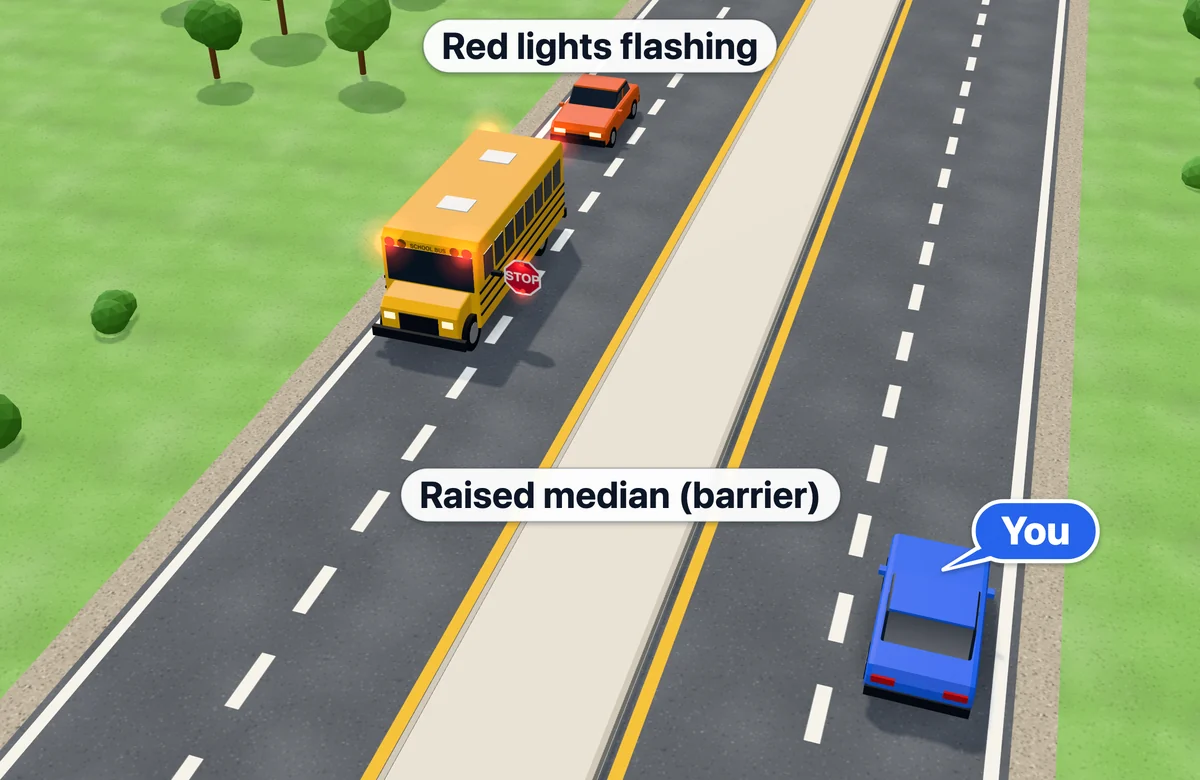
A school bus with flashing red lights is stopped on the other side of a divided highway. What should you do?
- A Continue carefully; you do not need to stop
- B Stop, then pass at no more than 10 mph
- C Stop until the red lights stop flashing
- D Pull onto the shoulder and wait
Show answer
A. Continue carefully; you do not need to stop
If the school bus is on the other side of a divided highway or a road with two or more lanes in each direction, you do not need to stop. Still watch for children near the road.