California Permit Practice Test 2
25 questions written from the California Driver's Handbook (DL 600), with an explanation and page citation for every answer.
As an adult California driver, which point total can lead to a license suspension as a negligent operator?
Keyboard: press 1–4 or A–D to answer, Enter for the next question, S to save, R to read aloud, P to pause reading, L to listen and answer.
About this test
These questions were written from the California Driver's Handbook (DL 600) (DL 600 ENGLISH). 14 of the 20 California questions in this test cover rules that are specific to California or differ between states. Every answer comes with an explanation and a link to the exact page it comes from, so you can check it yourself.
Your answers are saved in this browser. Questions you miss go to My mistakes so you can practice them again.
Sample questions from this test
As an adult California driver, which point total can lead to a license suspension as a negligent operator?
- A 4 points in 36 months
- B 4 points in 12 months
- C 3 points in 12 months
- D 6 points in 36 months
Show answer
B. 4 points in 12 months
California counts points over rolling periods: 4 points in 12 months, 6 in 24 months, or 8 in 36 months can lead to suspension. Most moving violations are worth one point, so a few tickets in a single year add up fast.
View diagram
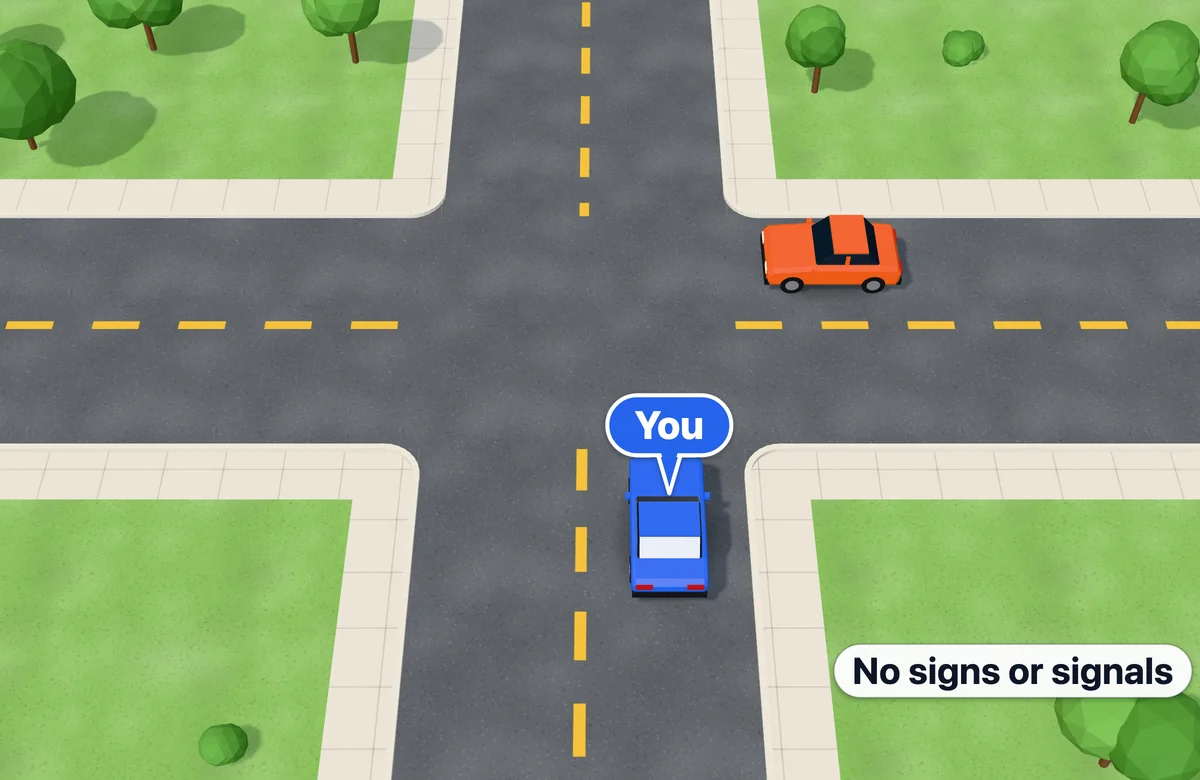
You reach an intersection with no stop signs, yield signs or traffic signals (an uncontrolled intersection). Another car reaches it at the same time from the cross street on your right. Who should go first?
- A The larger of the two vehicles
- B Whichever car is going straight
- C You do, because you are on the left
- D The car on your right
Show answer
D. The car on your right
At an intersection without STOP or YIELD signs, the vehicle that arrives first goes first. If you arrive at the same time, give the right-of-way to the vehicle, pedestrian or bicyclist on your right. Here the other car is on your right, so you wait and let it go.
You are 17 and hold a California provisional license. Under the law for drivers under 18, when may you use a cell phone while driving, even a hands-free one?
- A When using a hands-free headset for calls
- B When stopped at a red light
- C Only to call for emergency help
- D Whenever the phone is mounted on the dash
Show answer
C. Only to call for emergency help
California bans drivers under 18 from using a cell phone or wireless device to make calls or text while driving, even hands-free. The only exception is calling for emergency help. New drivers need all their attention on the road.
You have a tire blowout at highway speed. What should you do?
- A Hold the wheel firmly and gradually release the gas
- B Lift your foot off the gas suddenly
- C Brake hard to stop as quickly as possible
- D Steer sharply onto the shoulder at once
Show answer
A. Hold the wheel firmly and gradually release the gas
In a blowout, hold the wheel with both hands, keep your speed if safe, and gradually release the gas. Once the car is stable, slow down and pull off the road.
Unless signs say otherwise, what is the maximum speed limit on most California highways?
- A 55 mph
- B 65 mph
- C 75 mph
- D 70 mph
Show answer
B. 65 mph
Unless otherwise posted, the maximum on most California highways is 65 mph. Some highways are posted higher, and two-lane undivided highways default to 55 mph.