California Permit Practice Test 5
25 questions written from the California Driver's Handbook (DL 600), with an explanation and page citation for every answer.
What does California's Basic Speed Law say?
Keyboard: press 1–4 or A–D to answer, Enter for the next question, S to save, R to read aloud, P to pause reading, L to listen and answer.
About this test
These questions were written from the California Driver's Handbook (DL 600) (DL 600 ENGLISH). 14 of the 20 California questions in this test cover rules that are specific to California or differ between states. Every answer comes with an explanation and a link to the exact page it comes from, so you can check it yourself.
Your answers are saved in this browser. Questions you miss go to My mistakes so you can practice them again.
Sample questions from this test
What does California's Basic Speed Law say?
- A You may exceed the limit by 5 mph to pass safely
- B Always drive at exactly the posted speed limit
- C Drive at the speed most other drivers are using
- D Never drive faster than is safe for current conditions
Show answer
D. Never drive faster than is safe for current conditions
Under the Basic Speed Law, you may never drive faster than is safe for current conditions, whatever the posted limit. Traffic, road surface, weather, and pedestrians or bicyclists all affect what speed is safe.
View diagram
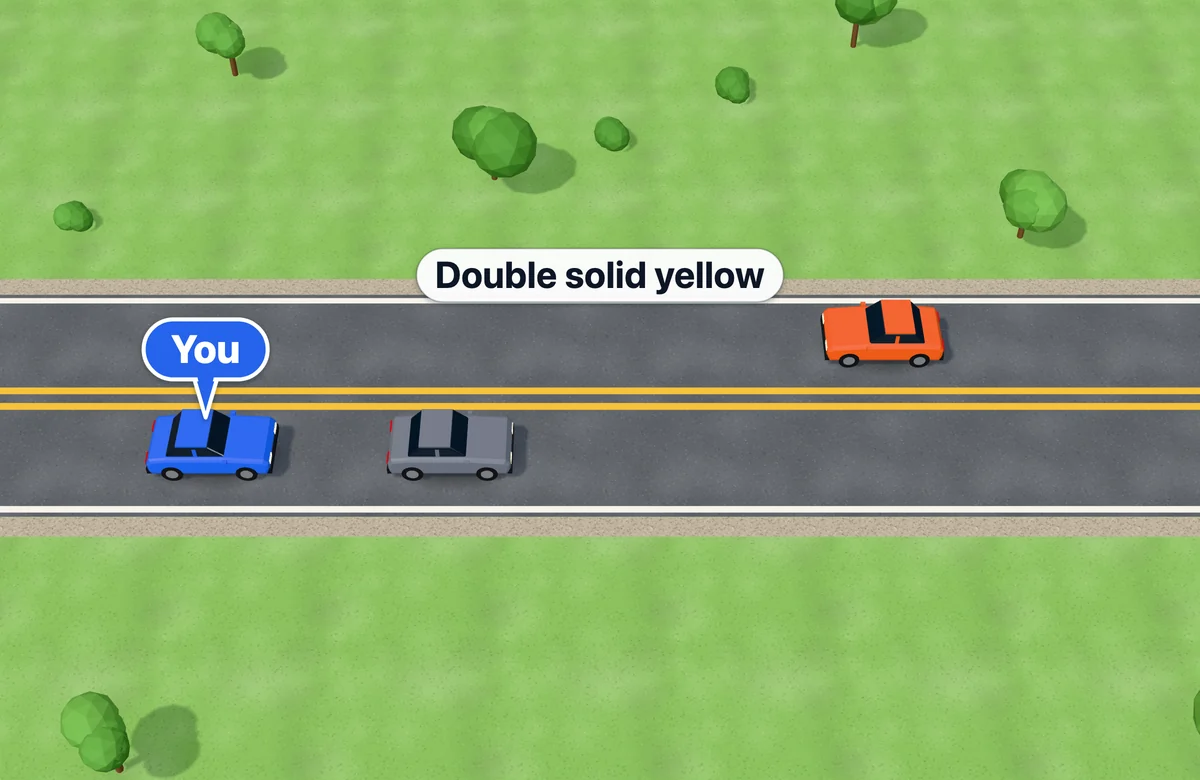
Your lane is separated from oncoming traffic by a single set of double solid yellow lines. When may you cross them?
- A Never; double yellow lines may not be crossed
- B Only to pass a bicyclist in your lane
- C To turn left into a driveway or make a U-turn
- D To pass a slow vehicle when the road ahead is clear
Show answer
C. To turn left into a driveway or make a U-turn
Do not pass over double solid yellow lines. You may cross a single set of them to turn left into or out of a driveway or private road, or to make a U-turn. Two sets spaced two feet or more apart form a barrier you may not cross.

What does a five-sided (pentagon) sign like this one warn you about?
- A A slow-moving vehicle is ahead
- B You are near a school
- C A no-passing zone begins
- D A railroad crossing is ahead
Show answer
B. You are near a school
A five-sided sign means you are near a school. Drive slowly and stop for children in the crosswalk.
A judge offers you traffic violator school for a one-point ticket. What does completing it do, and how often can you use it?
- A Erases the ticket from your record; allowed once in any 12-month period
- B Keeps the ticket from your insurer; allowed once in any 18-month period
- C Keeps the ticket from your insurer; allowed once in any 36-month period
- D Erases the ticket from your record; allowed once every 24 months
Show answer
B. Keeps the ticket from your insurer; allowed once in any 18-month period
Traffic violator school keeps a one-point citation from being reported to your insurance company, but it stays on your DMV record. You can use this option only once in any 18-month period, so it is not a way to wipe out repeated tickets.
You reach a T intersection with no STOP or YIELD signs, and you are on the road that ends. Who has the right-of-way?
- A You, because you arrived first
- B The vehicle on your right
- C Traffic on the through road
- D Whoever is turning left
Show answer
C. Traffic on the through road
At a T intersection without signs, vehicles, bicyclists and pedestrians on the through road have the right-of-way. The driver on the road that ends must wait for a safe gap.