Colorado permit test: parking & stopping
Where you may not park, distances from hydrants and crossings, curbs and hills. 6 questions.
In Colorado, how close to a fire hydrant may you park?
Keyboard: press 1–4 or A–D to answer, Enter for the next question, S to save, R to read aloud, P to pause reading, L to listen and answer.
Sample parking & stopping questions
In Colorado, how close to a fire hydrant may you park?
- A No closer than 5 feet
- B No closer than 15 feet
- C No closer than 30 feet
- D No closer than 10 feet
Show answer
B. No closer than 15 feet
You may not park within 15 feet of a fire hydrant. Firefighters need clear access to connect hoses quickly.
In Colorado, you may not park within how many feet of a stop sign or traffic signal?
- A 30 feet
- B 50 feet
- C 15 feet
- D 20 feet
Show answer
A. 30 feet
You may not park within 30 feet of a traffic signal, stop sign or railroad crossing. A parked car there would hide the sign or signal from approaching drivers.
When you parallel park, how close to the curb must your vehicle be?
- A Within 30 inches
- B Within 24 inches
- C Within 18 inches
- D Within 12 inches
Show answer
D. Within 12 inches
Where parallel parking is allowed, your vehicle must be within 12 inches of the curb, or as close as possible to the edge of the shoulder, so traffic is not blocked or slowed.
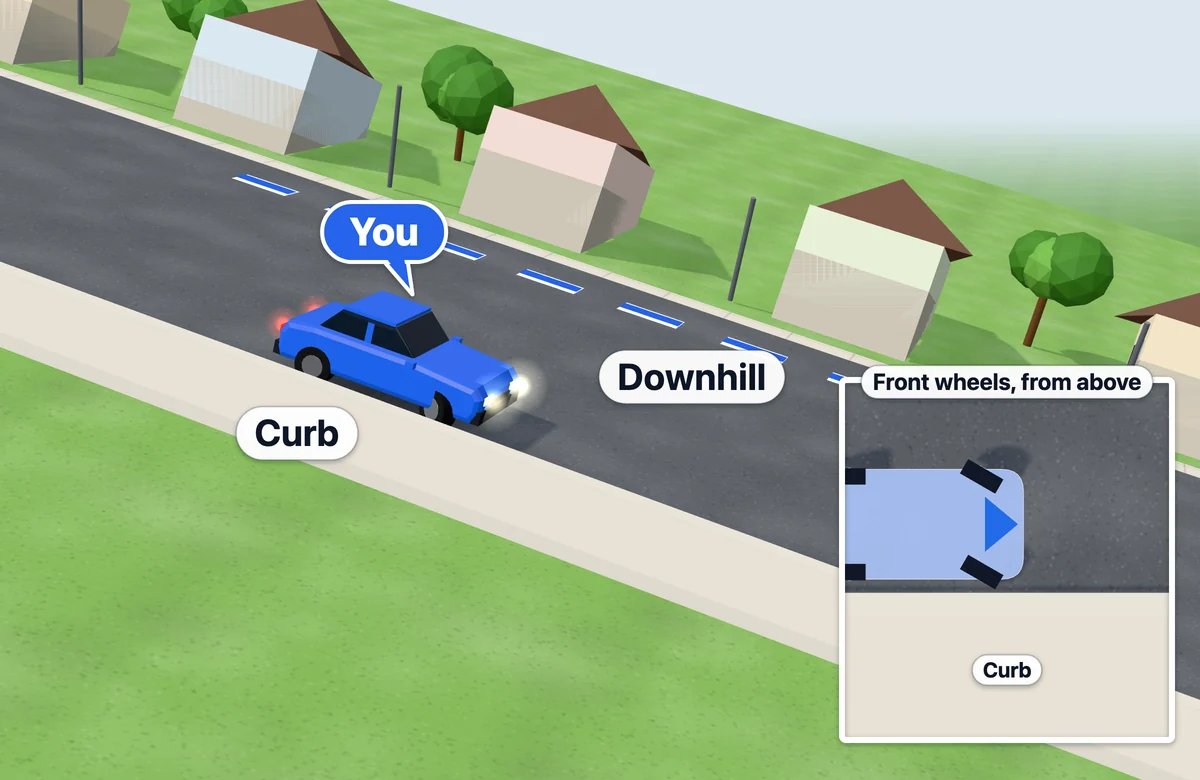
View diagram
You park facing downhill next to a curb. Which way should you turn your front wheels?
- A Toward the center of the road
- B Away from the curb
- C Toward the curb
- D Straight ahead
Show answer
C. Toward the curb
When parked downhill, turn your front wheels toward the curb and let the car roll slowly until the front tire rests against the curb. The curb then acts as a block.