Colorado permit test: turning & signaling
Turn lanes, turn signals, hand signals, U-turns and turns on red. 5 questions.
In an urban area, how far before a turn or lane change must you signal continuously in Colorado?
Keyboard: press 1–4 or A–D to answer, Enter for the next question, S to save, R to read aloud, P to pause reading, L to listen and answer.
Sample turning & signaling questions
In an urban area, how far before a turn or lane change must you signal continuously in Colorado?
- A 100 feet
- B 200 feet
- C 300 feet
- D 50 feet
Show answer
A. 100 feet
In urban areas, you must signal continuously for 100 feet before turning or changing lanes. On four-lane highways with limits above 40 mph, the distance is 200 feet. A good rule of thumb is at least 3 seconds.
On a four-lane highway with a 55 mph limit, how far ahead must you signal before turning or changing lanes?
- A 50 feet
- B 100 feet
- C 500 feet
- D 200 feet
Show answer
D. 200 feet
On four-lane highways where the posted limit is faster than 40 mph, you must signal for 200 feet before a turn or lane change. At higher speeds, other drivers need more warning.
View diagram
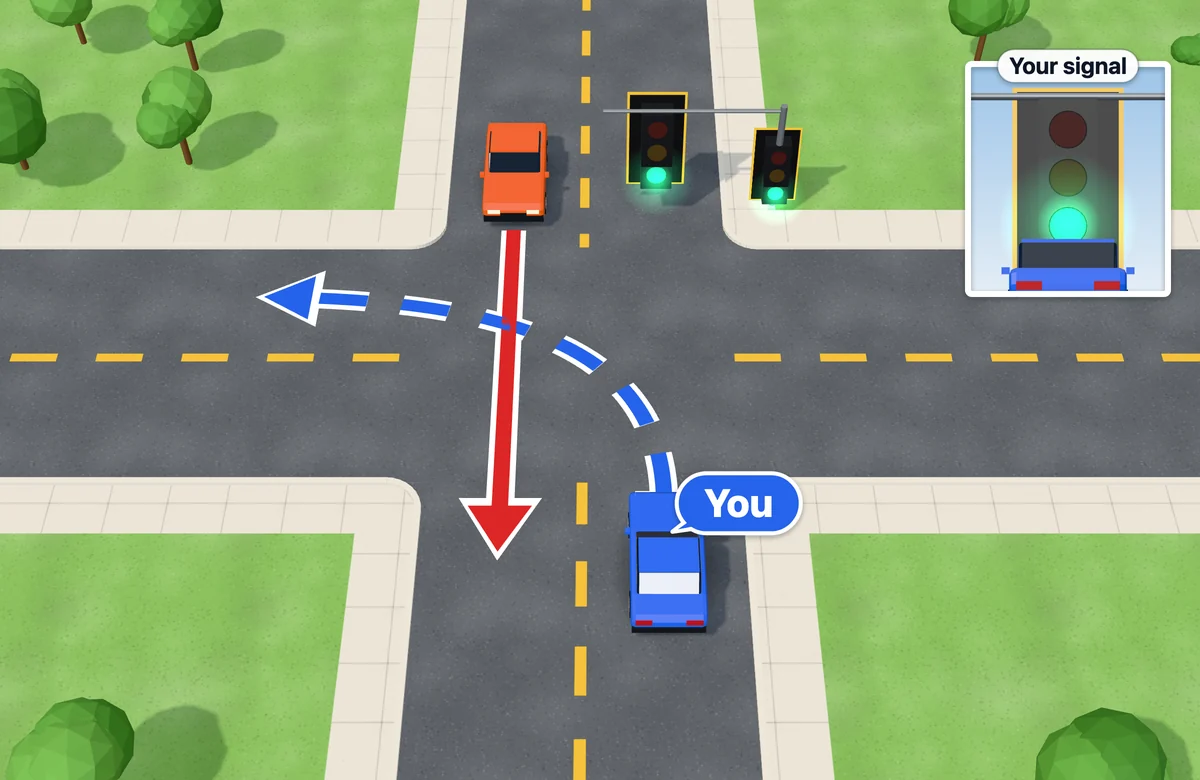
You are stopped waiting to turn left across oncoming traffic. How should your front wheels be pointed?
- A Turned to the right, toward the curb
- B Turned to the left, ready to go
- C Straight ahead until you begin the turn
- D It does not matter while you are stopped
Show answer
C. Straight ahead until you begin the turn
Never turn your front wheels left while waiting to turn. If you are rear-ended, turned wheels would push you into oncoming traffic. Keep them straight until you actually begin the turn.
View diagram
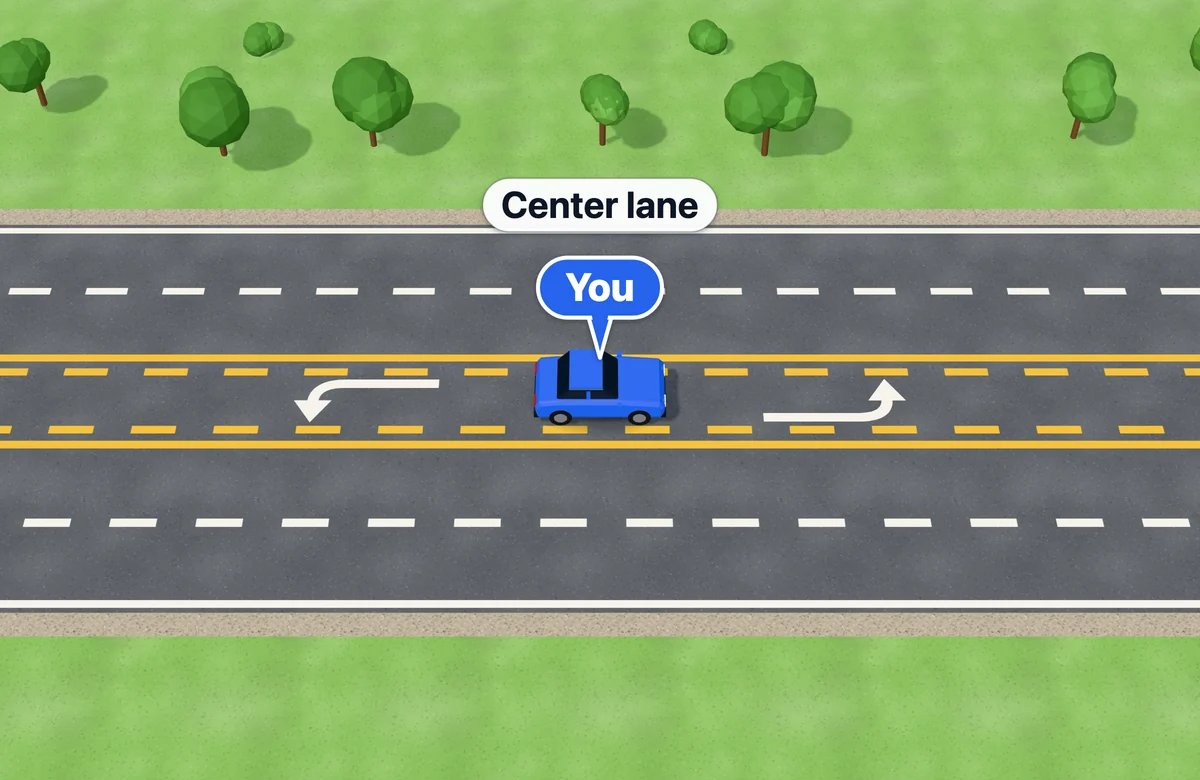
How may a two-way left-turn (center turn) lane be used?
- A For merging onto the street after a right turn
- B Only for making left turns, by drivers from either direction
- C For traveling until your exit appears
- D For passing slow vehicles
Show answer
B. Only for making left turns, by drivers from either direction
A two-way left-turn lane is for the exclusive use of left-turning vehicles from either direction. You may stop in it until it is safe to turn, but you may not use it for passing or travel.