Idaho permit test: railroad crossings
Crossing signs and signals, when to stop and what to do if stuck. 5 questions.
When you are required to stop at a railroad crossing in Idaho, where should you stop?
Keyboard: press 1–4 or A–D to answer, Enter for the next question, S to save, R to read aloud, P to pause reading, L to listen and answer.
Sample railroad crossings questions
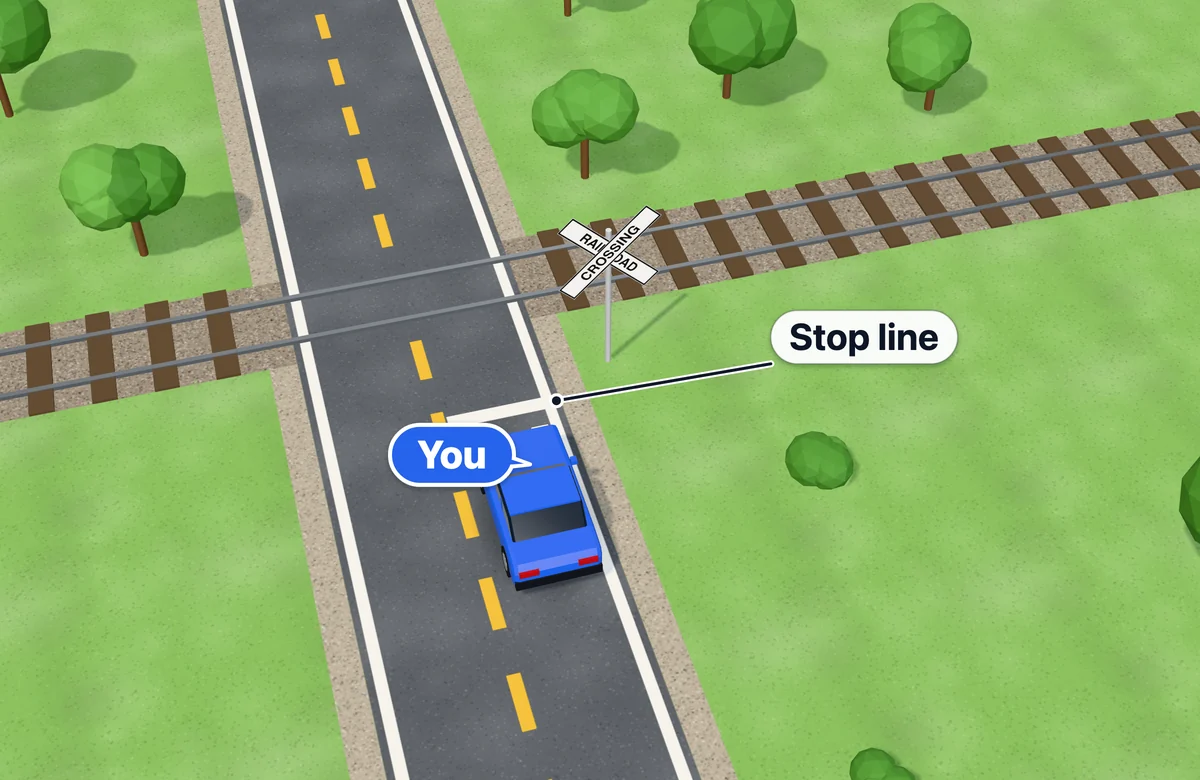
View diagram
When you are required to stop at a railroad crossing in Idaho, where should you stop?
- A Within 100 feet but no closer than 50 feet from the nearest rail
- B Within 30 feet but no closer than 10 feet from the nearest rail
- C Directly at the edge of the nearest rail
- D Within 50 feet but no closer than 15 feet from the nearest rail
Show answer
D. Within 50 feet but no closer than 15 feet from the nearest rail
Stop within 50 feet but not less than 15 feet from the nearest rail. Fifteen feet keeps you clear of the train, while 50 feet keeps you close enough to see down the tracks.
Source: Idaho Driver's Handbook, page 60
Why should you never shift gears while driving across railroad tracks?
- A It may cause your vehicle to stall on the tracks
- B It wears out the transmission faster
- C It is illegal to shift gears within 100 feet of a crossing
- D It sets off the crossing signals
Show answer
A. It may cause your vehicle to stall on the tracks
Shifting gears while crossing tracks can stall your vehicle right where a train could hit it. Choose your gear before you reach the crossing and drive straight across.
Source: Idaho Driver's Handbook, page 61
Traffic is backed up on the far side of a railroad crossing. When may you start across the tracks?
- A When the car ahead of you has started across
- B When no train can be seen in either direction down the tracks
- C Only when your whole vehicle has room on the other side
- D When the crossing signals are not flashing
Show answer
C. Only when your whole vehicle has room on the other side
Never start across the tracks unless there is enough room for the full length of your vehicle on the other side. Never stop with any part of your vehicle on the track.
Source: Idaho Driver's Handbook, page 61
About how far does a 150-car freight train going 50 mph need to stop?
- A About 700 feet
- B About 7,000 feet, or more than a mile
- C About 2,000 feet
- D About 450 feet
Show answer
B. About 7,000 feet, or more than a mile
A 150-car freight train at 50 mph needs about 7,000 feet, or 1 1/3 miles, to stop. A train cannot stop for you, so it is up to you to stay off the tracks.
Source: Idaho Driver's Handbook, page 60