Idaho permit test: turning & signaling
Turn lanes, turn signals, hand signals, U-turns and turns on red. 5 questions.
In a business or residential area in Idaho, how far ahead must you begin signaling before a turn?
Keyboard: press 1–4 or A–D to answer, Enter for the next question, S to save, R to read aloud, P to pause reading, L to listen and answer.
Sample turning & signaling questions
In a business or residential area in Idaho, how far ahead must you begin signaling before a turn?
- A At least 50 feet
- B At least 200 feet
- C At least 5 seconds
- D At least 100 feet
Show answer
D. At least 100 feet
Idaho requires your signal to start at least 100 feet before a turn or lane change in business or residential areas, and at least five seconds before on freeways or highways. Early signals help prevent rear-end crashes.
Source: Idaho Driver's Handbook, page 72
View diagram
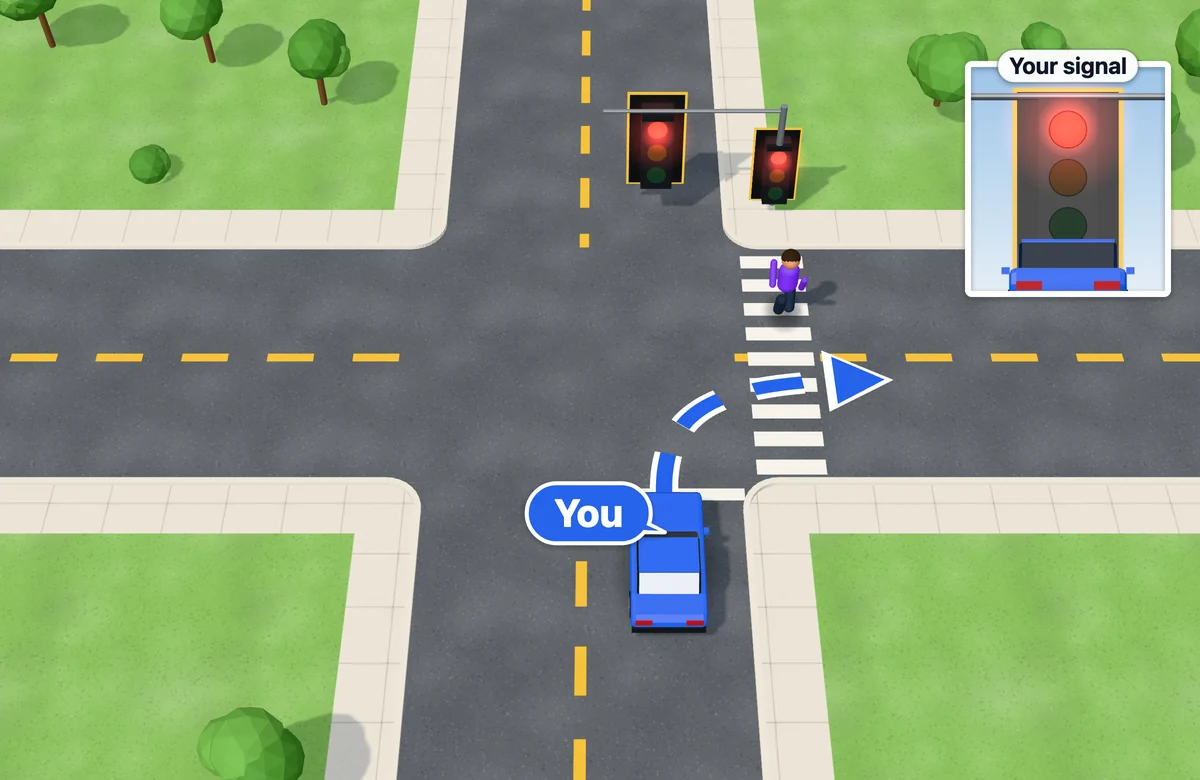
You are stopped at a steady red light and want to turn right. No sign prohibits it. What may you do?
- A Turn without stopping if the way is clear
- B Stop, yield to cross traffic and pedestrians, then turn
- C Wait for the green light, because turns on red are illegal
- D Turn only if a sign says right turn on red allowed
Show answer
B. Stop, yield to cross traffic and pedestrians, then turn
At a steady red light, Idaho lets you turn right after a complete stop and after yielding to cross traffic and pedestrians, unless a sign says otherwise.
Source: Idaho Driver's Handbook, page 73
In Idaho, when may you turn left on a steady red light?
- A When turning onto a one-way street, after stopping and yielding to cross traffic
- B From any street onto any street, after stopping and yielding
- C Only when turning onto a two-way street with a center turn lane
- D Never; left turns on red are always illegal
Show answer
A. When turning onto a one-way street, after stopping and yielding to cross traffic
At a steady red light, Idaho lets you turn left onto a one-way street after a complete stop and after yielding to cross traffic, unless a sign prohibits it. This includes turning from one one-way street onto another. A left on red onto a two-way street is not allowed.
Source: Idaho Driver's Handbook, page 69
Near the crest of a hill, approaching drivers could see your car from only 300 feet away. May you make a U-turn there?
- A Yes, if you signal for at least five seconds
- B Yes, as long as no cars are in sight
- C No, approaching drivers must be able to see you within 500 feet
- D No, approaching drivers must be able to see you within 1,000 feet
Show answer
C. No, approaching drivers must be able to see you within 500 feet
U-turns are not allowed on curves or near the crest of a hill where approaching drivers cannot see you from within 500 feet in either direction. They are also illegal in no-passing zones and where U-turns are posted as prohibited.
Source: Idaho Driver's Handbook, page 73