Texas permit test: pavement markings
Yellow and white lines, passing zones, crosswalks, stop lines and special lanes. 4 questions.
There is a solid yellow line on your side of the center line. What does it mean?
Keyboard: press 1–4 or A–D to answer, Enter for the next question, S to save, R to read aloud, P to pause reading, L to listen and answer.
Sample pavement markings questions

View diagram
There is a solid yellow line on your side of the center line. What does it mean?
- A You may pass if no one is coming
- B The lane ends ahead
- C The lane is for left turns only
- D You may not pass from your side
Show answer
D. You may not pass from your side
A solid yellow line on your side marks a no-passing zone. A broken line on your side lets you pass when it is safe.
What does a double solid white line between lanes mean?
- A Crossing it is prohibited
- B You may cross it to pass slower traffic
- C It separates traffic moving in opposite directions
- D It marks the edge of a bike lane only
Show answer
A. Crossing it is prohibited
Crossing is prohibited where there are double solid white lines. A single solid white line should be avoided where possible, and double lines must not be crossed at all.
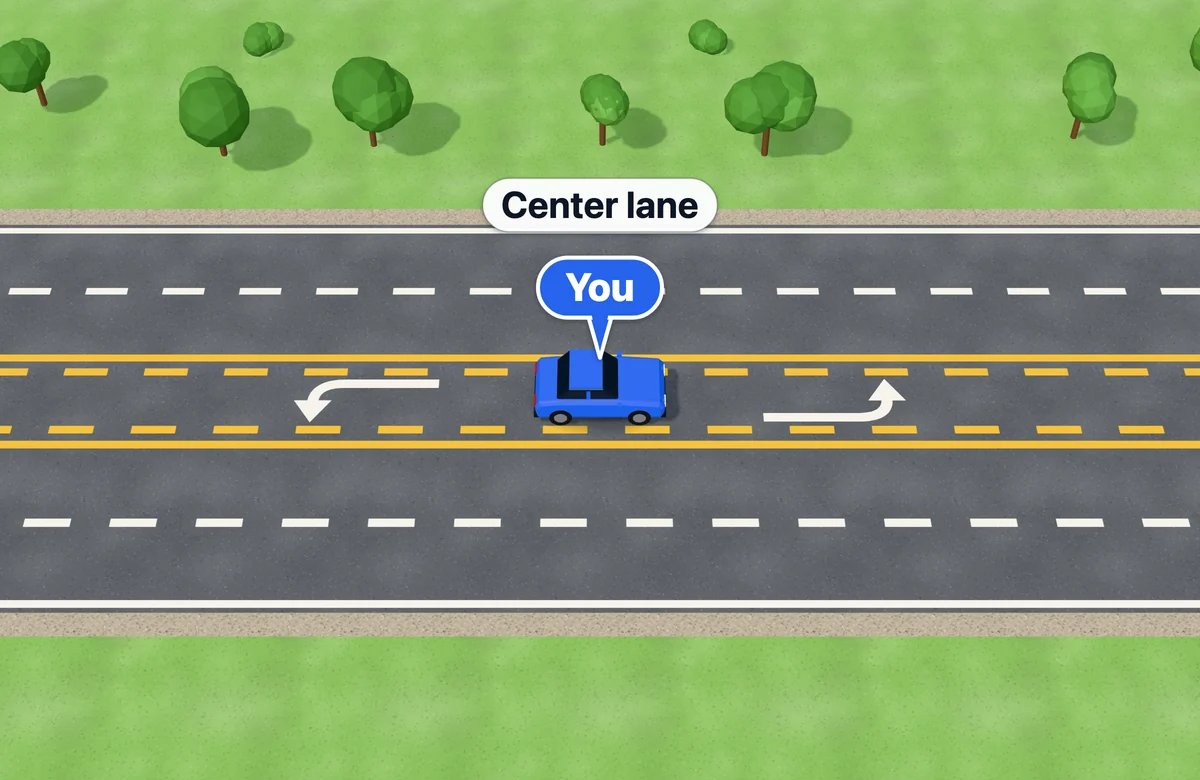
View diagram
When may you enter a center two-way left-turn lane?
- A Whenever you want to pass slower traffic
- B Only where you will have time to slow or stop for a safe left turn
- C To travel several blocks before turning
- D Only when the light at the next corner is red
Show answer
B. Only where you will have time to slow or stop for a safe left turn
The center lane is only for vehicles turning left, never for passing or through traffic. Enter it only where you will have time to slow down or stop for a safe turn.
There is a white stop line painted across your lane at a stop sign. Where should you stop?
- A With your front bumper over the line
- B At the edge of the cross street
- C Anywhere you can see cross traffic
- D Behind the stop line
Show answer
D. Behind the stop line
When white stop lines are present at signs or signals, you must stop behind them. Where there are none, stop before the crosswalk.