Utah permit test: lanes, passing & merging
Lane choice, changing lanes, blind spots, passing rules and merging. 4 questions.
After passing on a two-lane road, how far from an oncoming vehicle must you be when you return to the right lane?
Keyboard: press 1–4 or A–D to answer, Enter for the next question, S to save, R to read aloud, P to pause reading, L to listen and answer.
Sample lanes, passing & merging questions
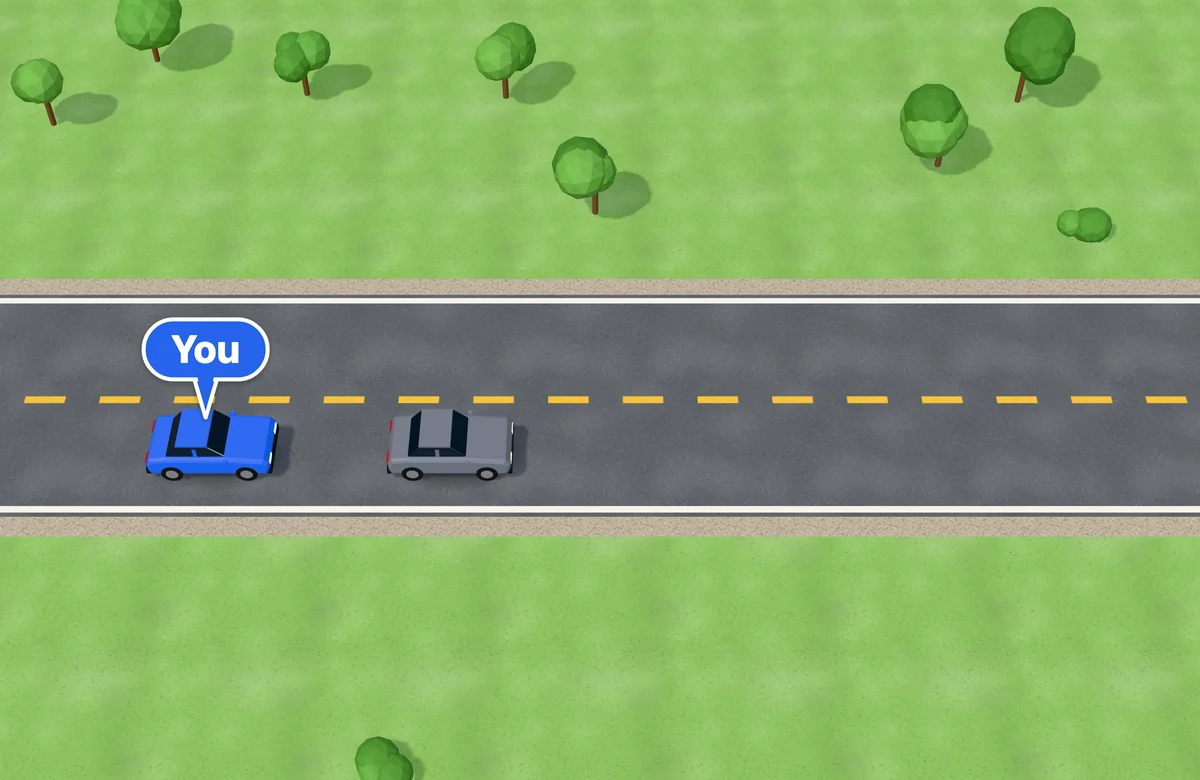
View diagram
After passing on a two-lane road, how far from an oncoming vehicle must you be when you return to the right lane?
- A No less than 500 feet
- B No less than 50 feet
- C No less than 100 feet
- D No less than 200 feet
Show answer
D. No less than 200 feet
When passing, return to the right-hand lane no less than 200 feet from oncoming vehicles. Then wait until you can see the passed car in your rear-view mirror, head check, signal and move back.
Source: Utah Driver Handbook (AAMVA Model Non-Commercial), page 44
Three snowplows are working side by side in echelon formation with flashing yellow lights. Where may you pass them?
- A You may not pass them on either side
- B On the right shoulder
- C On the side away from the blades
- D On the left side only
Show answer
A. You may not pass them on either side
You may not pass a single plow with flashing yellow lights on the side where its blade is down. If three or more plows work in echelon formation, you may not pass them on either side.
Source: Utah Driver Handbook (AAMVA Model Non-Commercial), page 44
Two lanes narrow to one at a busy construction zone. What does Utah expect drivers to do?
- A Use both lanes up to the merge point, then take turns merging
- B Move into the open lane as soon as you see the sign
- C Stay in the ending lane and force your way in at the end
- D Stop in the closing lane until the open lane is empty
Show answer
A. Use both lanes up to the merge point, then take turns merging
Utah calls this the zipper method: at a congested merge, use both lanes until the merge point, then alternate into the single lane. Breaking this rule is an infraction.
Source: Utah Driver Handbook (AAMVA Model Non-Commercial), page 41
When changing lanes, what should you do after checking your mirrors and signaling?
- A Rely on your mirrors because they show everything
- B Check your blind spot by looking over your shoulder
- C Slow down sharply before moving over
- D Change lanes right away while the signal is on
Show answer
B. Check your blind spot by looking over your shoulder
Before a lane change, check your mirrors, signal for at least two seconds, and turn your head to check your blind spot. Then merge when safe and cancel your signal.
Source: Utah Driver Handbook (AAMVA Model Non-Commercial), page 40