Utah permit test: sharing the road
Pedestrians, bicyclists, motorcyclists, trucks, buses and slow vehicles. 7 questions.
What is the minimum distance Utah law requires when you pass a bicyclist?
Keyboard: press 1–4 or A–D to answer, Enter for the next question, S to save, R to read aloud, P to pause reading, L to listen and answer.
Sample sharing the road questions
What is the minimum distance Utah law requires when you pass a bicyclist?
- A 1 foot
- B 3 feet
- C 2 feet
- D 5 feet
Show answer
B. 3 feet
Utah requires at least three feet between your vehicle and any bicyclist or other vulnerable road user you pass. Give more room and slow down when you can.
Source: Utah Driver Handbook (AAMVA Model Non-Commercial), page 85
At night, within what distance must you dim your headlights when approaching or overtaking a bicyclist?
- A 300 feet
- B 500 feet
- C 1,000 feet
- D 200 feet
Show answer
B. 500 feet
Dim your headlights within 500 feet when approaching or overtaking a bicyclist at night. Bright lights can blind a rider who has little room to recover.
Source: Utah Driver Handbook (AAMVA Model Non-Commercial), page 85
How far behind a large truck can its rear blind spot extend?
- A Up to 500 feet
- B Up to 200 feet
- C Up to 20 feet
- D Up to 50 feet
Show answer
B. Up to 200 feet
Large vehicles have blind spots up to 200 feet behind them. If you are too close, the driver cannot see you and you cannot see what is ahead, so keep back and stay where the driver can see you in the mirrors.
Source: Utah Driver Handbook (AAMVA Model Non-Commercial), page 90
View diagram
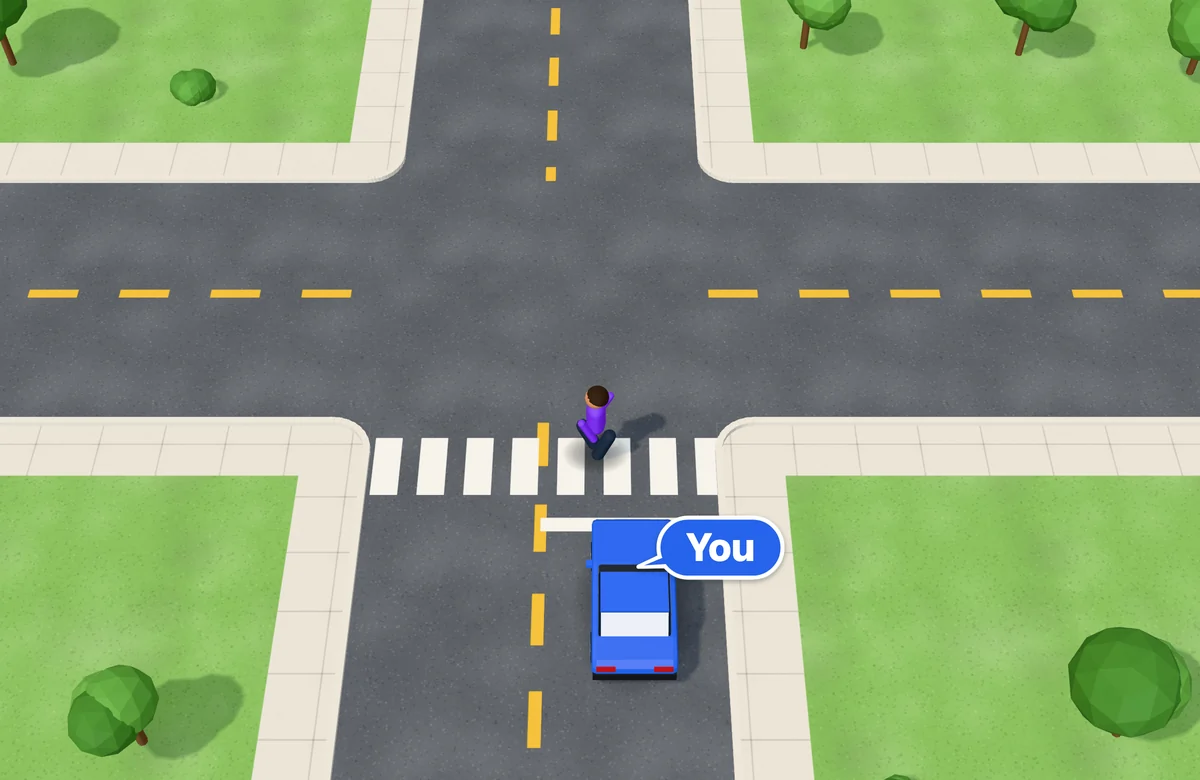
A pedestrian is crossing in front of you. How long must you stay stopped?
- A Until the pedestrian reaches the center of your lane
- B Until the pedestrian waves you on
- C Until the pedestrian has crossed at least your half of the road
- D Only until the pedestrian is out of a marked crosswalk
Show answer
C. Until the pedestrian has crossed at least your half of the road
Drivers must stay stopped until a pedestrian has crossed at least the driver's half of the road, even outside a crosswalk. Be especially careful at mid-block crossings, which may not be marked.
Source: Utah Driver Handbook (AAMVA Model Non-Commercial), page 92