Virginia permit test: railroad crossings
Crossing signs and signals, when to stop and what to do if stuck. 4 questions.
Your car stalls on a railroad track and a train is coming. What should you do?
Keyboard: press 1–4 or A–D to answer, Enter for the next question, S to save, R to read aloud, P to pause reading, L to listen and answer.
Sample railroad crossings questions
Your car stalls on a railroad track and a train is coming. What should you do?
- A Get out and run away in the direction the train is going
- B Stay in the car and keep trying to start it
- C Push the car off the tracks
- D Get out and run diagonally away, toward the train
Show answer
D. Get out and run diagonally away, toward the train
Get out right away and run diagonally away from the tracks toward the oncoming train. When the train hits your car, debris flies forward in the direction the train is traveling, so moving toward the train keeps you out of its path.
View diagram
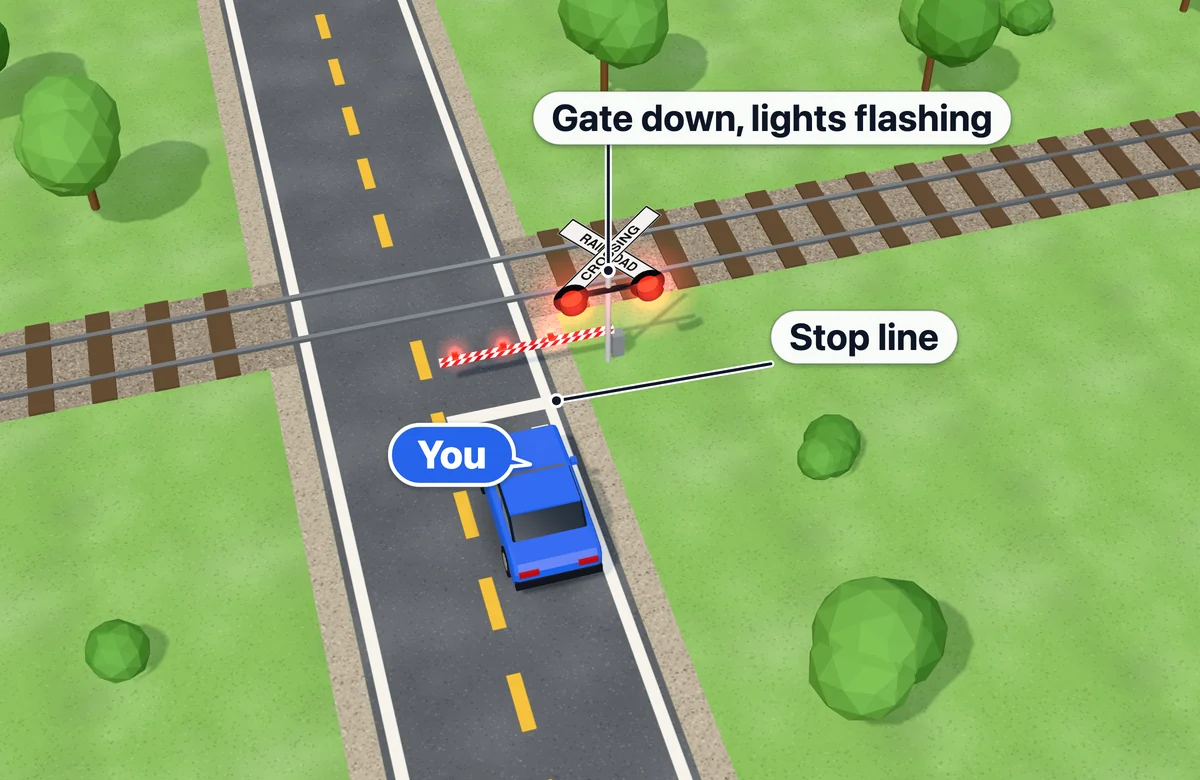
At a railroad crossing with gates, how long must you stay stopped?
- A Until the gates start to rise
- B Until the train you saw has passed
- C Until the gates rise and the lights stop flashing
- D Until you see no train either way
Show answer
C. Until the gates rise and the lights stop flashing
Stop when the lights begin to flash and before the gate lowers. Stay stopped until the gates are raised and the lights stop flashing, and never drive around a lowered gate.
A train has just passed at a crossing with several tracks. Why should you still be careful before crossing?
- A Railroad workers may still be crossing the tracks
- B A second train may be coming the other way
- C The gates often fail after a train
- D The first train may back up
Show answer
B. A second train may be coming the other way
At multitrack crossings, a second train can come from the opposite direction, hidden by the first. Wait until the lights stop flashing and you can see the tracks are clear.
Traffic is backed up just past a railroad crossing. When should you start across the tracks?
- A When the crossing lights are off
- B When the car ahead starts to move
- C When no train is in sight
- D Only when there is room to clear the tracks completely
Show answer
D. Only when there is room to clear the tracks completely
Never start across unless you can clear the tracks completely. Make sure there is room for your whole vehicle on the other side so you do not get stuck on the tracks.