Virginia permit test: turning & signaling
Turn lanes, turn signals, hand signals, U-turns and turns on red. 6 questions.
How far ahead of a turn should you start signaling, according to the Virginia manual?
Keyboard: press 1–4 or A–D to answer, Enter for the next question, S to save, R to read aloud, P to pause reading, L to listen and answer.
Sample turning & signaling questions
How far ahead of a turn should you start signaling, according to the Virginia manual?
- A At least 50 feet (about 1 to 2 seconds)
- B At least 100 feet (about 3 to 4 seconds)
- C At least 200 feet (about 7 to 10 seconds)
- D Only as you begin to turn the wheel
Show answer
B. At least 100 feet (about 3 to 4 seconds)
Signal at least three or four seconds, or about 100 feet, before you turn. Early signals tell drivers and pedestrians what you are about to do so they can react.
View diagram
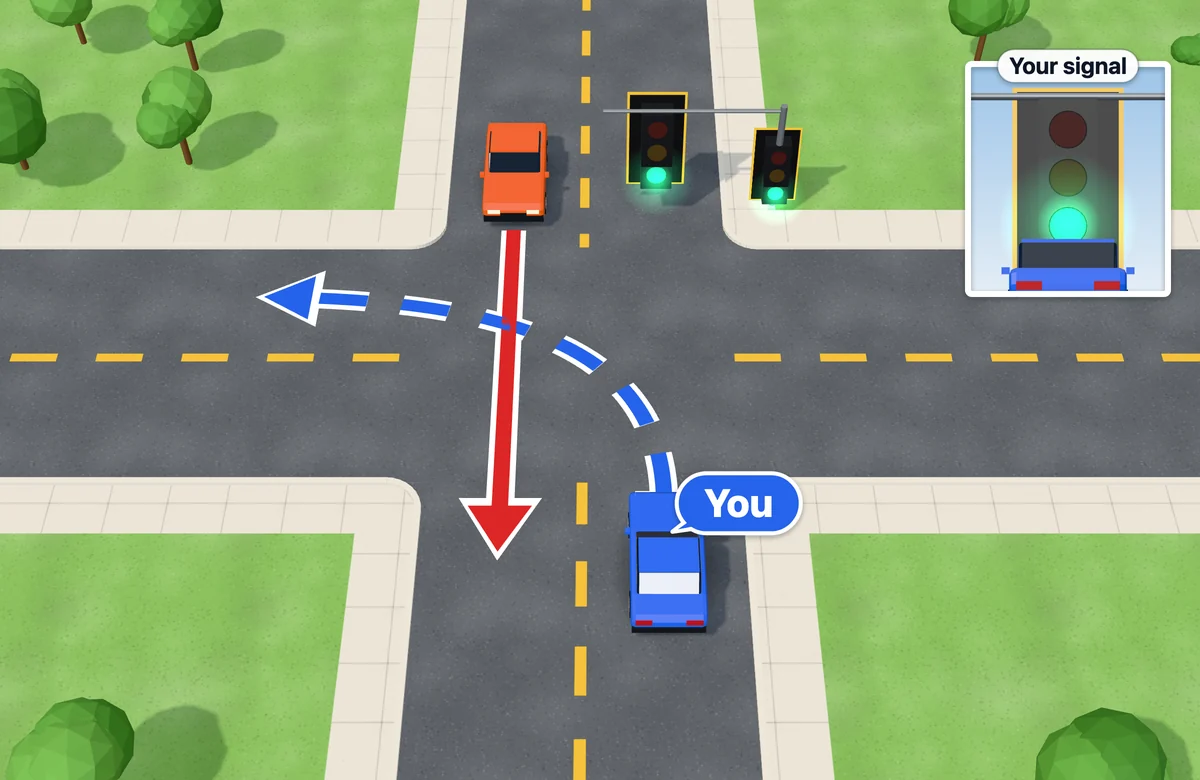
You are stopped, waiting to turn left across oncoming traffic. How should your front wheels be pointed?
- A Turned left so you are ready to go
- B It does not matter while you are stopped
- C Turned right, toward the curb
- D Straight ahead until you start the turn
Show answer
D. Straight ahead until you start the turn
Keep your front wheels straight while waiting to turn left. If another vehicle hits you from behind, you will be pushed forward instead of into oncoming traffic.
You and an oncoming driver are both turning left at the same intersection. How should you turn?
- A In front of each other, passenger sides beside each other
- B Behind each other, driver sides beside each other
- C The driver on the right turns first
- D One at a time; the first to arrive goes first
Show answer
A. In front of each other, passenger sides beside each other
When two opposing vehicles both turn left, each should turn in front of the other so their passenger sides pass beside each other. This keeps the paths from crossing and lets each driver see oncoming traffic.
Where may you make a U-turn in a Virginia business district?
- A Only in the middle of a block
- B Only at an intersection
- C Only at a driveway entrance
- D Anywhere with a gap in traffic
Show answer
B. Only at an intersection
In business districts, cities and towns, U-turns are allowed only at intersections, and never on a highway. Check first for No U-Turn or No Left Turn signs.