Illinois Permit Practice Test 4
25 questions written from the 2026 Illinois Rules of the Road, with an explanation and page citation for every answer.
It starts to rain and you turn on your windshield wipers. What else does Illinois law require?
Keyboard: press 1–4 or A–D to answer, Enter for the next question, S to save, R to read aloud, P to pause reading, L to listen and answer.
About this test
These questions were written from the 2026 Illinois Rules of the Road (2026). 15 of the 20 Illinois questions in this test cover rules that are specific to Illinois or differ between states. Every answer comes with an explanation and a link to the exact page it comes from, so you can check it yourself.
Your answers are saved in this browser. Questions you miss go to My mistakes so you can practice them again.
Sample questions from this test
It starts to rain and you turn on your windshield wipers. What else does Illinois law require?
- A Nothing else during daylight
- B Turn on your hazard flashers
- C Turn on your headlights
- D Turn on your high beams
Show answer
C. Turn on your headlights
Illinois law requires your headlights to be on whenever you use your windshield wipers. Headlights help other drivers see you in rain, snow or fog.
You are in a crash in Illinois and no police officer is at the scene. Besides any crash that injures or kills someone, you must notify police right away if property damage is more than:
- A $2,500 (or $1,000 if any vehicle is uninsured)
- B $1,000 (or $250 if any vehicle is uninsured)
- C $1,500 (or $500 if any vehicle is uninsured)
- D $500, whether or not the vehicles are insured
Show answer
C. $1,500 (or $500 if any vehicle is uninsured)
When no officer is present, Illinois law requires immediate notice to police by the fastest available means if a crash injures or kills anyone, or causes property damage over $1,500 (over $500 if any vehicle involved is uninsured). Reporting quickly gets help to the scene and creates an official record of the crash.
Source: Illinois Secretary of State, Driver Services Department website
View diagram
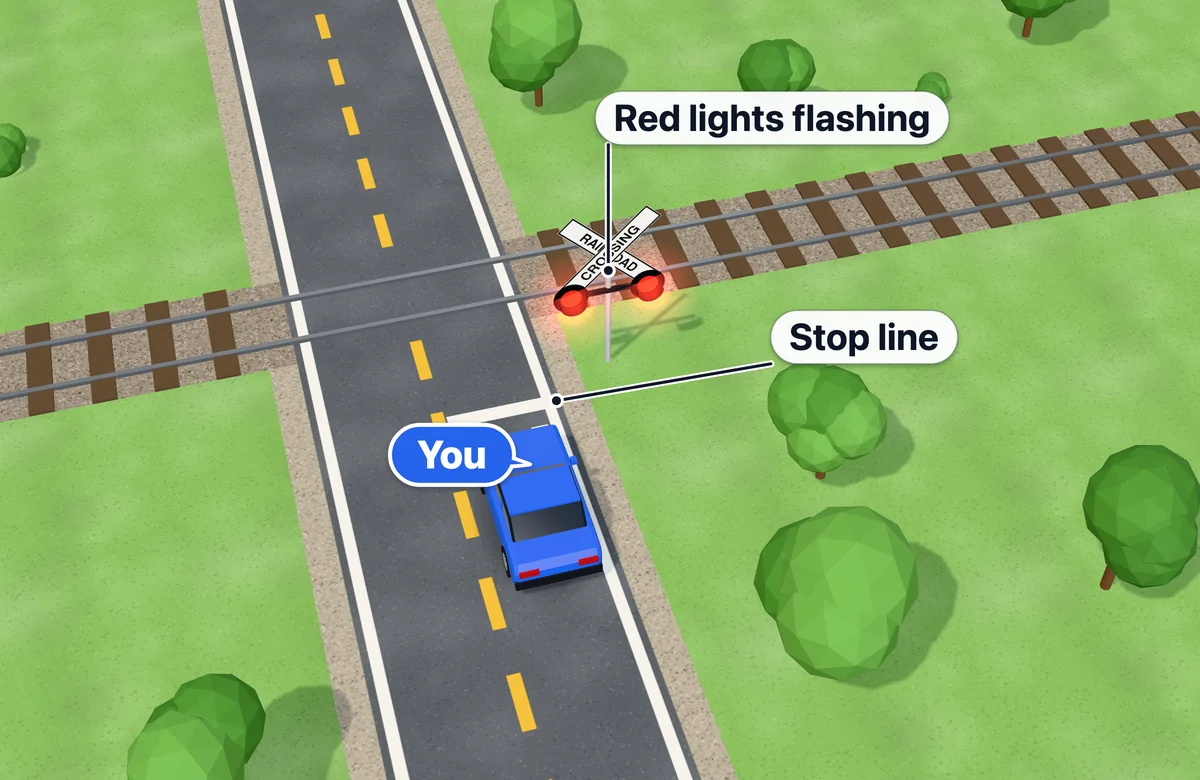
The lights are flashing at a railroad crossing. How far from the tracks must you stop in Illinois?
- A Exactly 100 feet
- B Between 5 and 10 feet
- C Between 15 and 50 feet
- D Between 50 and 100 feet
Show answer
C. Between 15 and 50 feet
Stop within 15 to 50 feet of the crossing when there is a stop sign, flashing signals, a lowered gate, a flagger's signal or an approaching train. Go only after the gate is up and the lights stop, then check for more trains.
If you are under 18, how long must you hold your instruction permit before you can get an Illinois driver's license?
- A At least 12 consecutive months
- B At least six consecutive months of practice
- C At least nine consecutive months
- D At least 90 days
Show answer
C. At least nine consecutive months
Illinois requires drivers aged 15-17 to hold the instruction permit for at least nine consecutive months. The long holding period means you practise through different seasons, weather and traffic before driving alone.
You are on the road that ends at a T intersection with no signs or signals. Who has the right of way?
- A You do, because you are on the right
- B Traffic on the through road; you must yield before crossing or turning
- C Whichever driver is turning left
- D Whoever arrives at the intersection first
Show answer
B. Traffic on the through road; you must yield before crossing or turning
At a T intersection with no traffic control, the driver on the ending (terminating) road must yield to traffic on the through road. The through road's drivers do not expect you to pull out.