Louisiana permit test: pavement markings
Yellow and white lines, passing zones, crosswalks, stop lines and special lanes. 5 questions.
What do double solid white lines between two lanes going the same direction mean?
Keyboard: press 1–4 or A–D to answer, Enter for the next question, S to save, R to read aloud, P to pause reading, L to listen and answer.
Sample pavement markings questions
What do double solid white lines between two lanes going the same direction mean?
- A You may cross them to pass with care
- B The lane on the left is for turning only
- C Crossing the lines is prohibited
- D Traffic on the other side goes the opposite way
Show answer
C. Crossing the lines is prohibited
Double solid white lines separate two lanes moving the same direction, and crossing them is prohibited. You see them most often on interstates, for example near ramps and special lanes.
At night you see red raised reflectors in the lane ahead of you. What do they tell you?
- A A railroad crossing is just ahead
- B The lane is reserved for buses
- C The lane ahead is closed for road construction work
- D You are facing the wrong way and must not enter
Show answer
D. You are facing the wrong way and must not enter
Red raised pavement markers or reflectors show that you are traveling against the direction of traffic. If you see them facing you, you are on a roadway you must not enter, so stop and turn around safely.
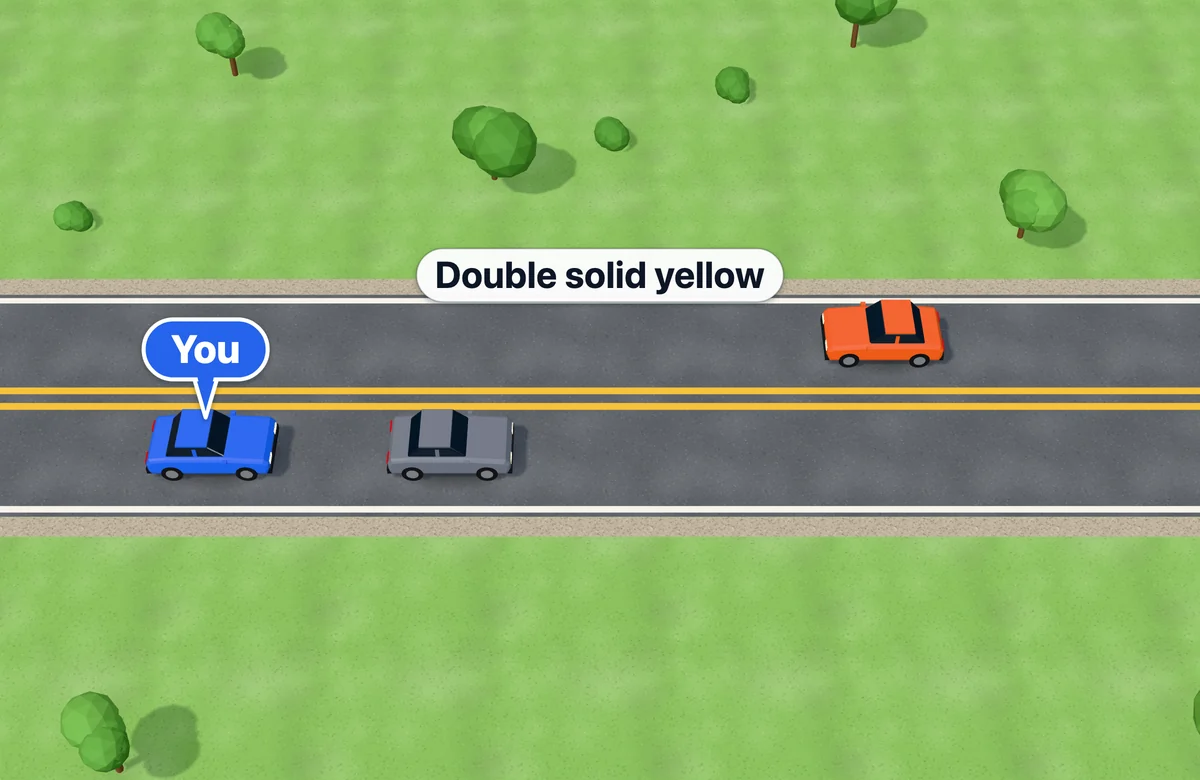
View diagram
Double solid yellow lines mark the center of the road. Which move across them is allowed?
- A Crossing them to pass a slow truck
- B Using the space between them as a lane
- C Crossing them to pass a bicyclist on a curve
- D Crossing them to make a left turn
Show answer
D. Crossing them to make a left turn
You may not cross double solid yellow center lines to pass, but you may cross them to make a turn, such as into a driveway. Yellow lines always separate traffic going in opposite directions.

View diagram
On a two-lane road, there is a solid yellow line on your side of the center and a dashed yellow line on the other side. What does this mean for you?
- A You may pass, but the other side may not
- B Neither direction may pass or turn
- C You may not pass, but drivers on the other side may
- D Both directions may pass when clear
Show answer
C. You may not pass, but drivers on the other side may
A single solid yellow line marks a no-passing zone for the traffic on that side. You may cross it only to make a turn, while drivers with the dashed line on their side may pass when safe.