Vermont permit test: railroad crossings
Crossing signs and signals, when to stop and what to do if stuck. 4 questions.
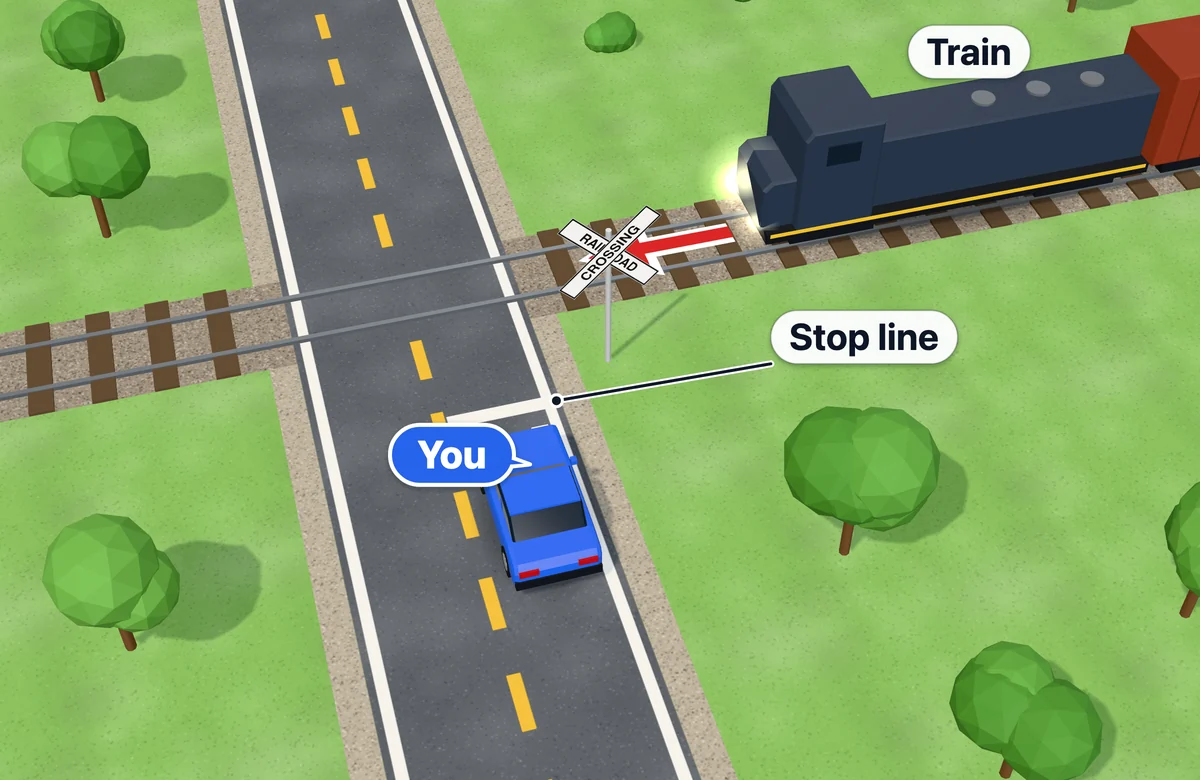
When a train is approaching a crossing, how far from the nearest rail must you stop?
Keyboard: press 1–4 or A–D to answer, Enter for the next question, S to save, R to read aloud, P to pause reading, L to listen and answer.
Sample railroad crossings questions
View diagram
When a train is approaching a crossing, how far from the nearest rail must you stop?
- A At least 5 feet
- B At least 15 feet
- C At least 50 feet
- D At least 100 feet
Show answer
B. At least 15 feet
Vermont law requires you to stop not less than 15 feet from the nearest rail when lights, gates, a flagger, a train or its whistle signal a train, or a stop sign is posted. Go only when it is safe.
View diagram
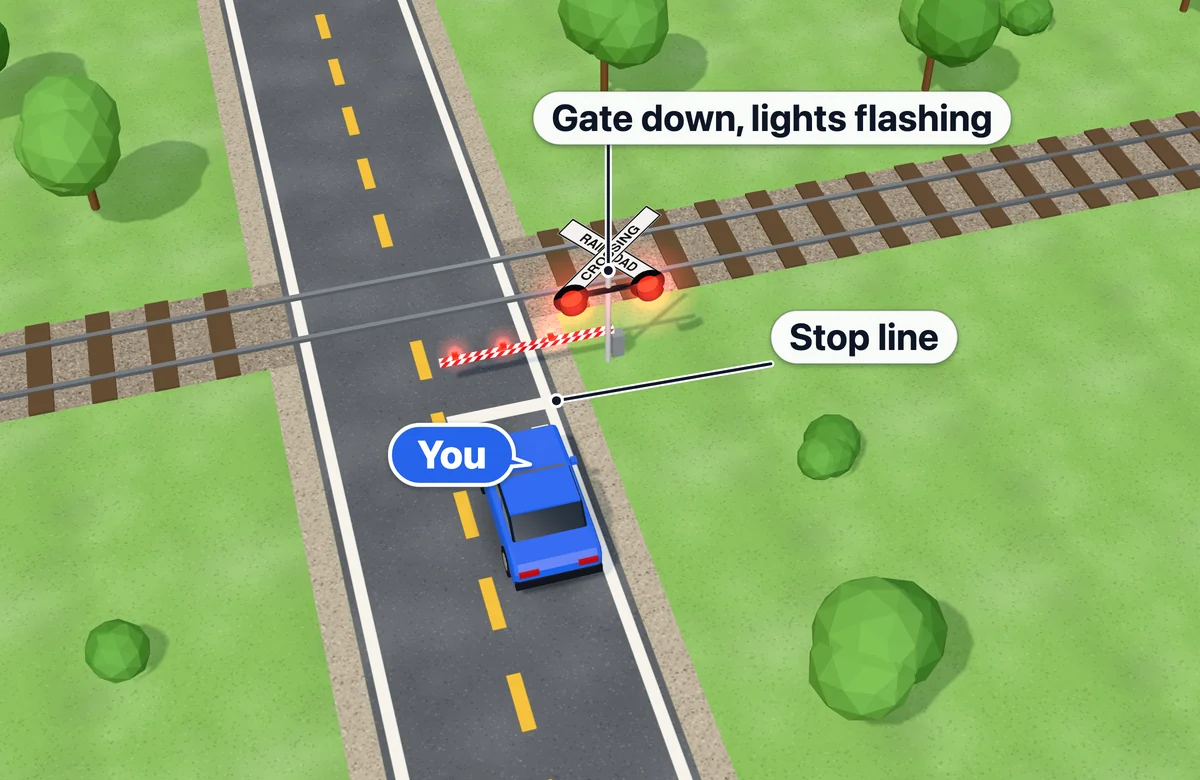
The gate at a railroad crossing is down, but you do not see a train. What should you do?
- A Drive around the gate carefully
- B Wait; driving around or under a closed gate is illegal
- C Back up and cross at an angle
- D Honk your horn and then cross if no train is visible at all
Show answer
B. Wait; driving around or under a closed gate is illegal
It is illegal to drive through, around or under a closed railroad gate. Wait until the gate rises and the signals stop.
You notice a dangerous problem at a railroad crossing, such as a stalled vehicle on the tracks. What should you do?
- A Call your insurance company and report the hazard to them
- B Wait for a train to stop on its own
- C Put flares on the tracks and leave
- D Call the number on the crossing's emergency sign
Show answer
D. Call the number on the crossing's emergency sign
Call the number on the crossing's emergency sign. Giving the posted crossing number lets the railroad stop or reroute trains until the hazard is cleared.
Is it legal to pass another vehicle at a railroad crossing?
- A Yes, if no train is visible
- B No, passing at a railroad crossing is against the law
- C Yes, but only on multilane roads with clear lanes in both directions
- D Yes, if the vehicle ahead is slow
Show answer
B. No, passing at a railroad crossing is against the law
It is against the law to pass another vehicle at a railroad crossing. Crossings are listed among the places you must not pass.