Vermont permit test: right of way & intersections
Who goes first at stops, uncontrolled intersections, roundabouts and when entering roads. 6 questions.
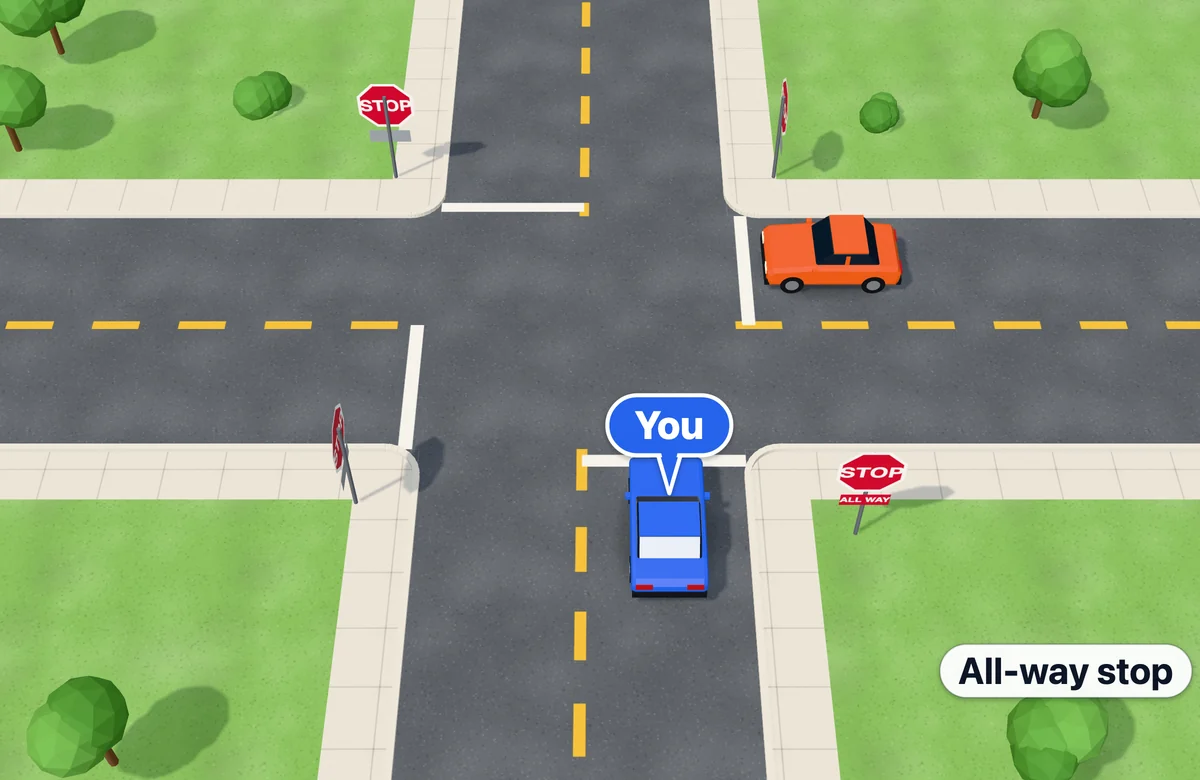
Two cars arrive at a four-way stop at about the same time from different directions. Who should yield?
Keyboard: press 1–4 or A–D to answer, Enter for the next question, S to save, R to read aloud, P to pause reading, L to listen and answer.
Sample right of way & intersections questions
View diagram
Two cars arrive at a four-way stop at about the same time from different directions. Who should yield?
- A The driver on the right yields to the driver on the left
- B The larger vehicle goes first
- C The driver on the left yields to the driver on the right
- D The driver going straight always goes first
Show answer
C. The driver on the left yields to the driver on the right
At a four-way stop, the first vehicle to arrive goes first. If two arrive at about the same time, the driver on the left yields to the driver on the right.
You are pulling out of a parking lot onto a road. Who has the right of way?
- A You, once you have signaled
- B Whoever is going faster
- C All traffic already on the road
- D You, if you reach the road first
Show answer
C. All traffic already on the road
A driver entering a road from a driveway, alley, parking lot or T-intersection must yield to all traffic on the road. Wait for a safe gap before pulling out.
You are turning left at an intersection and a bicyclist is coming toward you. Who has the right of way?
- A The oncoming bicyclist
- B You, because you were there first
- C You, because a car is larger
- D Whoever signals first
Show answer
A. The oncoming bicyclist
When turning left, you must yield to all oncoming traffic, motor vehicles and bicyclists alike. Bicyclists may be going faster than you think, so give them room.
You enter a two-lane roundabout with no signs or arrows and want to turn left. Which lane should you use?
- A The right lane
- B The left lane
- C Either lane
- D Whichever lane is empty
Show answer
B. The left lane
In a two-lane roundabout with no signs or arrows, the right lane is for right turns or going through, and the left lane is for left turns or going through. You may not change lanes inside the roundabout.