Vermont permit test: turning & signaling
Turn lanes, turn signals, hand signals, U-turns and turns on red. 5 questions.
Under Vermont law, how far before a turn or lane change must you signal?
Keyboard: press 1–4 or A–D to answer, Enter for the next question, S to save, R to read aloud, P to pause reading, L to listen and answer.
Sample turning & signaling questions
Under Vermont law, how far before a turn or lane change must you signal?
- A At least 50 feet
- B At least 200 feet
- C At least 100 feet
- D At least 500 feet
Show answer
C. At least 100 feet
Vermont law requires a turn signal at least 100 feet before a turn or lane change. Signaling 3 to 5 seconds ahead covers this requirement.
When preparing to turn left on a two-way road, where should you position your car?
- A About three feet from the right edge
- B Within one foot of the center line, if safe
- C Straddling the center line
- D In the middle of your lane
Show answer
B. Within one foot of the center line, if safe
Before a left turn, move within one foot of the center line if it is safe. Keep your wheels straight while waiting so a rear-end crash does not push you into oncoming traffic.
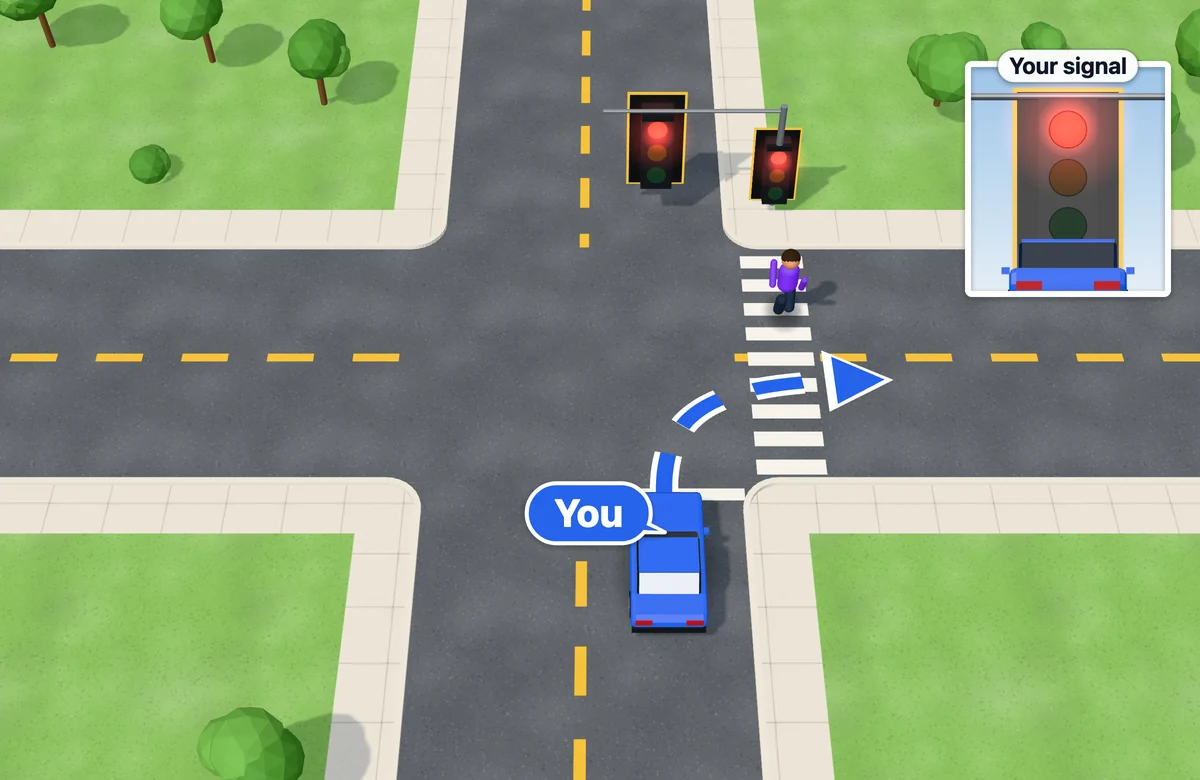
View diagram
Your traffic light is red and there is no sign prohibiting turns. May you turn right in Vermont?
- A Yes, after a complete stop and yielding to pedestrians and traffic
- B No, right turns on red are illegal in Vermont
- C Yes, and without a full stop, as long as the whole intersection is clear
- D Only if a green arrow is also lit
Show answer
A. Yes, after a complete stop and yielding to pedestrians and traffic
Right turns on a circular red are usually allowed in Vermont, but only after a complete stop, a scan of the intersection, and yielding to pedestrians and vehicles. Obey any sign that forbids it.
You are in a lane marked with a straight-ahead arrow and realize you needed to turn right. What should you do?
- A Turn right from your lane if no one is beside you
- B Stop and wait for the right lane to clear
- C Continue straight and find another route
- D Signal and cut into the right lane at the intersection
Show answer
C. Continue straight and find another route
You must follow the direction shown for the lane you are in. If you are in a straight-only lane, go straight; it is safer to drive around the block than make a sudden turn.